Sunday, November 5, 2017

Night train to Chiang Mai

I take back what I said about Germans being the only other backpackers talking to us. Oh sure, a German couple sat down at our table one night at a traveler-oriented restaurant (not great, but T. was suffering football withdrawal), and we talked with them for a while. For some reason T. always seems to meet Liverpool supporters. We ran into them again the next evening on the Sunday “walking street” of Chiang Mai. That’s when the whole street is pedestrianized and filled with booths, plus food vendors in the courtyards of the Buddhist temples. And they were friendly.

But nobody starts, or keeps up, a conversation like someone from the U.S.A. And travelers from the U.S., while plentiful in this part of the world, are also kind of a breed apart. As has been observed, it is highly unusual and difficult for Americans to take significant time to travel, compared with most other Western countries. So while backpacking is almost a rite of passage for many middle-class Europeans or Australasians, in order to do this type of traveling, Americans have to be more countercultural, like their hippie predecessors. 

We started talking to a couple at our guesthouse (or rather, they started talking to us). He was originally from Indiana and she from Kansas, but they looked and sounded like they’d left the Midwest long behind. They had been living in New York, but now were bound for a working holiday in Australia, to save up money for their travels in Europe. They talked of “burning their lives” back in New York, and clearly, what they’ve done is radical by U.S. standards. Of course, we thought it was great.

Then there was the day we left Chiang Mai in the morning, to get a bus to Chiang Rai. We got to the bus station in plenty of time, but the next bus with seats available didn’t leave for nearly five hours. Earlier in our travels—say Madrid—the prospect of spending all day on a three-hour bus journey would have felt like a major setback, but we’ve slowed down so much now that it didn’t faze us at all. We just settled in on a patio for an hour or two, had coffee and sandwiches, and caught up on our friends the Lawsons’ travel blog. Then we found seats back at the bus station. Trish got out the sewing kit to attach my latest country patch, Thailand, to my day pack.
No time is wasted.
Then this young foreign woman came and sat down opposite. “Do you speak English?” she said, in a voice that neither of us had difficulty hearing. I knew she was from the United States before she said so.

The next two hours passed like no time at all. I can tell you everything about this gal now, except her name: her history of sobriety; what injuries she’s had; her business that allows her to travel for weeks at a time (always a question where an American is concerned); how old her dog is; when her dad quit smoking; her dietary issues and allergies; how much her vaccinations cost. And, most relevantly, where she’s traveled and where she was going next. Chiang Rai, as it happened. We barely had to say a word, and when we did, it was just her cue to tell us another thing about her own life.

If I went on a date with someone this self-absorbed, I’d throw myself out the window; but she was the best thing that could happen to us in a bus station. God bless her, this is what you have to do if you’re traveling on your own. Americans are the best at it. The day we met the elephants, it was the solo American in our group who made us a group: she took seven disparate people and turned us into friends for the day.

We walked with them while they foraged for food.
She, and the elephants. T. has already blogged about our experience with the pioneer of ethical elephant interactions; it remains for me to add some pictures of my own. 

The encounters between large numbers of elephants and people at the Elephant Nature Park were all booked up, but this turned out to be a blessing in disguise. A small group, in a remote mountain village, meeting four elephants and their mahouts from the Karen tribe, was the kind of win-win experience I like most.
The bamboo floor took some getting used to.
Asian elephants have been used as beasts of burden for thousands of years, and these Karen people used to work in logging with the elephants. The numerous “hill tribes” of Thailand do not have Thai citizenship in most cases. The phrase “Third World” is not used much these days, but when I was growing up, we knew the Second World to be those countries aligned with the communist superpower, the U.S.S.R. You might say the hill tribes are almost Fourth World people, belonging neither to the developing nation in which they live, nor to the First World.

So they have enough problems, and now logging is outlawed in Thailand. This is doubtless good for the environment and for sustaining people’s future, and I’m sure the elephants don't miss logging; but it did throw their mahouts out of work. Many of them took to using their elephants in tourist interactions such as riding, shows, and street begging. These are at least as painful and unnatural for the elephants as logging was. Fortunately, Elephant Nature Park and its imitators are recruiting mahouts to turn to ethical elephant encounters instead.
We appreciated the traditional Karen tribal clothing.

Especially in the mud bath!
It made us feel good, because we weren’t contributing to the problem. The Karen are making money from their elephants again, and the elephants’ lives are free from abuse. Doesn’t get much better than that. Plus, it was amazing!
Grandma elephant at bath time

We had reached Chiang Mai aboard the overnight train, “old Number 9” as Libba Cotten sang in “Freight Train.” I was still feeling the effects of a second day on a bicycle, rented from the guy who called me “K-now-les.” The announcements aboard the train were in Thai, English, French, and a fourth language which I guessed was Chinese. Clearly, we weren’t the only foreigners aboard Train #9 (our German friends were with us too).

If we hadn’t already known we were backpackers, our simplified expectations for guesthouses should have made it clear. A shower hanging off the bathroom wall, nothing separating the shower from the toilet area? No problem. When our guesthouse in Ayuthaya offered a shower before we boarded the overnight train, T. was all ready to climb under a tree in the backyard—we were pleasantly surprised to find it was a room!

Smile House, Chiang Mai
Our guesthouse in Chiang Mai was supposed to have once been a safe house for Khun Sa, infamous opium lord of the Golden Triangle. I don’t know about that, but it was a very relaxed place to hang out, swim, talk to Americans, etc.  And, I finally had a chance to try boat noodles, the rich broth-based dish invented in Ayuthaya, at a no-frills place down the street. The guy in front sat on an overturned boat stirring a big pot, and we were the only foreigners. Boat noodles and an iced coffee for 85 baht. We ate there every lunch we were in town.

Chiang Mai was so relaxing after Bangkok, and inertia set in. I just wanted to stay and wander around the old city, where we were staying. We did manage to leave the city gate and cross the Nawarat Bridge, where we found this striking building from the era of teak logging.

This is First Church, founded by the Laos Mission from North Carolina in 1868. We visited on a Sunday, but as it’s now used as the Chiang Mai Christian School, there were no services.

This being Thailand, we had to tour some temples also. One of the most interesting experiences was actually outside Was Chedi Luang, where some schoolgirls asked if we would speak with them on video. It was a project for their English class. They talked to us for so long they almost could have been Americans (their English was very good too)!
Most of the elephants at the base of the tall ruined pagoda are reconstructions, but this one is original.
After all this, we were ready for a rot daang (red truck) ride back to our safe house. The rot daang is just what it says, a pickup truck with a cover and facing bench seats put in the back. It passes for a taxi or dalla dalla in most of Thailand. We were also ready for a beer, but 7-Eleven, which is almost literally on every corner, doesn’t sell booze between 2:00 and 5:00 P.M. (or lots of other times). Before I got to Thailand I’d heard rumors to the effect the country was a sleazy free-for-all, but I sure got the opposite impression on the ground!

We continued our hit-and-miss with Thai food—some hot and delicious, some cold and/or completely unappetizing. For a change, we tried a Burmese restaurant one night. Everything there was delicious, but unfortunately, I can’t remember what any of it was called.

Nothing could compare to our day in Karen garb being followed down a river path by elephants. However, we did make it to Doi Inthanon National Park, which is the highest mountain in Thailand. It felt a bit like cheating to reach the summit of Doi Inthanon, since it was accessible by minibus! But we did hike down from it, to the Pha Dok Siao waterfall and through terraced rice fields. Our guide, and the village of Mae Klang Luang, belonged to another Karen tribe.
The view from the king and queen's pagodas is better than from the summit itself.

Pha Dak Siao waterfall, Mae Klang Luang hiking trail
These particular folks, who are Roman Catholic, grow and sell coffee. Like many people in the “Golden Triangle” where Thailand meets Myanmar (Burma) and Laos, they used to grow opium. Nowadays the illicit production of opium has shifted to Afghanistan, and the good people of Mae Klang Luang are producing a more acceptable addictive drug. (Delicious, by the way.) 

We also visited a market run by Hmong women. The Hmong are another hill tribe, with a reputation in Thailand for being good at business (their reputation in neighboring Laos is somewhat different, as we shall discover). Several samples in I was talked into buying a bottle of lychee wine, only to realize that I had no corkscrew. This not being Europe, I can’t find one, either. I knew I should have packed that damn Swiss Army knife.

We were going to leave Chiang Mai on the 3rd of November, until our ever-helpful American from elephant day told us the Loy Krathong and Yee Peng festivals were about to begin. These festivals mark the full moon of the last lunar month, so the date is only nailed down one month in advance. Loy Krathong involves floating lanterns made out of flowers down the river, while Yee Peng involves the more dubious practice of releasing paper lanterns into the sky. Both, as far as I understand, represent letting go of negative things at the end of the year.

It’s a marker of how different things are here that no one thinks anything of letting thousands of people float lit candles off into the air. Sure, what could go wrong? We opted to float a krathong down the river and not participate in Flaming Litterfest.
Only sign of the fire department

I often think, if the attitude towards safety in Africa or Asia was averaged together with what now prevails in our home countries, we might achieve some happy medium. Like my childhood, which was a little bit dangerous, but not filled with fear of everything that might possibly happen. Then again, back then we genuinely thought a dolphin show was about the intelligence of the animals, and rode elephants without thinking we were doing any harm. 

People learn to do better. Maybe there is hope for humans and the species with which we share this earth.
Me and Mae-Yung

Monday, October 30, 2017

Individual style: Ayuthaya, Thailand

Kinds of transportation we’ve taken in Thailand since the airplane: Metered taxi, subway, elevated train, tuk-tuk (a 3-wheeled golf cart that passes for a taxi in most places), Chao Phraya Express Boat, train, rickety ferry, and sahm-lor (a bicycle rickshaw and not designed for two passengers, but that’s another story).

And bicycles. Riding a bike is that archetypal thing one never forgets how to do, and T. knew I could ride one. She didn’t, though, expect that I would. After all, I’d never really ridden in any kind of traffic, and it had been years since I was on a bike at all.

Biking past Wat Phutthai Sawan, a still-active temple and the first built off the island
 I was glad to have surprised her. Ayuthaya, the old capital north of Bangkok, is a small city on an island, and much of it is ruins of its glory days (1300s-1700s). It’s the ideal size to pedal around on a cheap bicycle, and after Bangkok, the traffic was nothing. Other than the hour or so we kept getting stuck behind a trash truck, I quite enjoyed it.
Aboard the Chao Phraya Express Boat, Bangkok
First, though, we had to get there. Ayuthaya is up the Mae Nam Chao Phraya, the river we’d toured by cheap public boat before we left Bangkok. Sadly, there’s no reasonably quick way to get there by boat, so we took the train. Third class. Cooled by wide open windows and fans hung from the ceiling. There were still bench seats available when we boarded, chatting all the while with a young German man who was headed to Ayuthaya for the day before boarding a night train to Chiang Mai. If it weren’t for Germans, we wouldn’t have any other backpackers to talk to.
From the window of the third-class train car
And if we didn’t feel like backpackers before, we did here. Our German friend Alex was going to get a "taxi" (tuk-tuk) for his day tour, but we were staying for a few nights. So we climbed aboard the ferry and crossed the Chao Phraya to the island.

When I say “ferry,” it was more like a large covered rowboat with an outboard motor. We saw it was departing and thought we’d wait five minutes for the next one, but the no-nonsense woman driving the ferry shot back to the jetty for us, so on we teetered. Not for the first time, I was glad we had only backpacks. The real fun was on the other side of the river, when we had to balance on a rickety board bridge forming three sides of a square, before finally arriving on dry land.

Later during our stay, the bike rental woman tried to convince us that the river was too high at the end of the rainy season to take a boat or ferry on. We just laughed.

T. had booked a place to stay over the phone, with an elderly woman who, upon learning that T. is from England, said, “Your English very good!” When I say elderly, I mean way past retirement age. Our hostess had one of those papery thin voices and didn’t even attempt to come up the stairs with us. Her guesthouse is a charming old schoolhouse made of teak wood, and still looks it (desks on the landings). 

We should have known something was amiss when we first walked in and saw a huge tree lying in the front yard. One of her employees waved us away from the fallen power lines. It turned out our hostess had no electricity and no water. Before we could even hit the hammock, she got off the phone and gave us the bad news that the electricity would not be fixed that afternoon, so we had to move on. “Good luck,” she said sweetly. “Leave now!”

So off we tramped around the corner to backpacker row, and found a room at the first guesthouse we came to. So much for booking things in advance! (Later during our stay, we biked past the elderly woman’s place and everything had been cleaned up, so I’m happy to report she’s fine.)

Not long ago, no window to look out of and a showerhead just hanging off the wall next to the toilet might have put us off taking a room. Now, paying Thai prices (maybe a third of what an Airbnb in Europe cost), we just thought, Hey, it’s spotless. The grass out front is green and the people are friendly. And our instincts proved correct: the next day, while we were drinking beer on the terrace, a shiny car from Bangkok pulled up, and an important-looking couple got out. They looked familiar (from formal portraits framed in the lobby, as it turned out). They were the owners, and used to seeing scruffy people hanging out in front of their house, as they chatted with us in a very friendly manner.

By the way, floors are spick and span because people take their shoes off everywhere. I haven’t gone barefoot this much since I grew up in Tennessee.

As in many other parts of the world, in Thailand motorcycles aren’t a statement but a way of getting around. Two Muslim women showing only their faces came by on a scooter, followed by two schoolgirls in uniform, followed by a whole family—dad, little girl, and mom—all under the same rain poncho. Did I mention it was pouring at the time? I was observing all this from a shelter while I waited for the rain to stop, since foolishly I’d set foot outside without my raincoat. Like almost everyone else I’d seen riding motorcycles in Africa or Asia, no one had helmets. 

The bike rental place did have a kind of helmet available for motorcyclists, just in case some foreigner wanted one. They weren’t like any helmets I ever saw before, but “any port in a storm” has become my favorite saying. We took two at no extra charge.

“Individual style!” the rental guy said. Meaning, he’d never seen someone on a bicycle wear a helmet before. Never mind; they coordinated with our outfits.

We saw a lot more birds in Ayuthaya than in Bangkok, where all I heard was a rooster along the canal. We also visited a lot more temples, or more accurately, ruins. During the centuries when Ayuthaya was the capital of Siam, its many temples and palaces glittered from afar, and merchants from around the world came to admire and trade. Some of them stayed.

In European history, the 14th to 18th centuries aren’t renowned as a time when religious difference was tolerated. I could think of many examples of Catholic kingdoms where Protestants were persecuted and vice versa, not to mention the many religious minorities who fled to America and other places. In Ayuthaya, however, it seems that there was space for different cultural groups to coexist. Peoples such as Lao and Khmer settled among the locals, while those from further away were given land by the king to build their own settlements.

We got directions from someone at the mosque at Friday prayer time.
Most of these settlements were across the river to the south. East of Wat Phutthai Sawan a Persian community settled, and the area is still Muslim today. St. Joseph Church was built by the French on land given to them by the king near the Christian Vietnamese settlement, and many people living in this community to this day are Catholic.
St. Joseph Church. The writing inside the church is in French.
There were also Dutch, English, Chinese, and Japanese villages, though nothing remains of most of these. Most of the Japanese people who settled in Ayuthaya were themselves Christians fleeing persecution back in Japan. I find these facts fascinating, because so often, history reads as if no one has ever gotten along. I had no idea that during the same years when Pilgrims were fleeing religious persecution in England, a Siamese king was making persecuted Christians feel at home.

The first Europeans to arrive, in Siam as in Mauritius, were from Portugal. There are still traces of the Portuguese settlement today, including the foundation of the first church in all of Thailand. St. Dominic was built in 1540 and we could still see this fascinating feature: a Thai-style spirit house, only with figures of saints inside. Two of them are St. Joseph and St. Paul. I’m not sure what Paul would make of this syncretism, but then, I’m not Catholic.

Both on and off the island, Ayuthaya is full of Buddhist temples, some of them still active. One of the active ones is Wihan Phra Mongkhon Bophit, which has the distinction of having been repaired with money from a Burmese government of the 1950s. You may recall that it was Burma that sacked Ayuthaya two centuries earlier, bringing its time as the Siamese capital to an end. It was nice of the prime minister to make this very belated gesture.

By far the coolest picture in Ayuthaya is at the ruins of Wat Mahathat.

All that remains of this sandstone Buddha is the head, around which have grown the entwined roots of a bodhi tree. I must admit that Shelley's "Ozymandias" went through my mind.

We were getting so confident on our bikes that we took a little detour to one more ruin, and this one didn’t even charge admission. How could it? Wat Lokayasutharam has a 42-m reclining Buddha, representing the Buddha at his death, i.e., when he passed into the state of nirvana. It was so impressive that we let some woman talk us into buying marigolds to pay tribute. The king, you know.
When I took this picture of the reclining Buddha, I didn't notice the reclining dog.
There were other women who “helped” us put our offerings in the right place and not commit faux pas. Afterwards, they showed us various amulets we could buy: one for money, one for men, and so forth. I was going to make a deal for two money ones, since I wouldn’t know what to do with a man; but I didn’t want to pay in any case.

On the actual day of the king’s cremation, we were wandering around trying to find the action, but gave up. We give up easily in the heat. That’s when the sahm-lor guy came by. We agreed that he would take us “home,” and on the price. Then he took us the complete opposite direction, to where everyone was lined up to pay their final respects to the king. We didn’t mind seeing this in fact, but when he asked for twice as much money, we decided he was crazy!

You know the joke about eating Chinese food and being hungry an hour later? It’s not a joke in Thailand. I don’t know if the portion sizes are just smaller because the people are; I always feel like I’ve had enough of Thai food, but I never stay full for very long. I have to keep going down to 7-Eleven and buying sandwiches and junk. Sometimes I even break down and order French fries. It’s a disgrace.


While I’m up eating every hour or so, I reflect on the many countries I read about on the African part of our travels. How many of them have the trappings of democracy, but supported by the military; or are “presidential republics, in practice authoritarian.” It’s a reminder how fragile democracy can be. I was obviously raised to believe, and always have believed, that the best form of government is to let people choose their own representatives. Lately, though, I’ve been wondering…
Wat Phra Si Sanphet. Monks in orange and everybody else in black

Thursday, October 26, 2017

The King and I...

We arrived at Mauritius airport for our flight to Bangkok. There was an interesting assortment of shops, including one with a person-sized stuffed dodo, a Happy Diwali sign, and a model ship. We were sorry to be leaving the heavily Indian-influenced island just before the festival of Diwali. What we didn’t realize was that in Thailand, our destination, the late king’s funeral was this month. 

Sure, I could have looked this up. I remembered that the king had died last year, but I wasn’t aware of how long the period of official mourning, as declared by the military government, would be.

I had some trepidation about traveling to Thailand on a one-way ticket. In South Africa, the airline official had insisted on seeing our onward plane tickets out of Mauritius, before letting us board our flight there. Officially, many countries’ immigration departments insist that you have a ticket out of the country before they will let you in, but in practice a one-way flight is usually okay (the immigration officers just need to be satisfied that you have the means to move on and aren’t planning to stay in their country illegally). The problem arises when the airline you fly out with wants proof that they won’t be liable for flying you back.

We don’t know when or how we’re leaving Thailand, so we had nothing to show the airline officer in Mauritius. Fortunately, all she did was ask us to promise that if the Thai authorities insisted we buy a ticket out of the country on the spot, we would do so, and her airline wouldn’t be liable! I thought that was pretty laid back of her. When we actually arrived in Bangkok, the Thai immigration officer who stamped us in asked us exactly zero questions, so entering on a one-way ticket was a total breeze.

On our ride in from the airport I was distracted by our taxi driver. The first one we got had never heard of our hotel (this has become a theme across the world) and couldn’t figure out where it was, so we didn’t leave the airport with him. The second one, it quickly became apparent, had a series of tics that caused him to cough, bang his head into the headrest (he had a special cushion for this purpose, I noticed), and various other things. Since none of them seemed to interfere with his driving—remarkably smooth for a taxi driver, in fact—I just relaxed and let him get on with it. It was like being driven by Rafael Nadal. Then I started seeing portrait after portrait of the late king, decked with marigolds.

King Bhumibol Adulyadej (the Great, Rama IX) was beloved of Thais. It is illegal to insult royalty in this country, but I don’t think that explains the reverence we are seeing. Until his death, King Bhumibol was the longest-reigning monarch in the world; most Thai people have no memory of any other king. Furthermore, although Thailand has been a constitutional monarchy since 1932, it has been a rough road in terms of democracy. Only one prime minister has fully served out his or her term. Under these circumstances, the occasional intervention of King Bhumibol behind the scenes (even though he had no formal government role) has probably given Thais some sense of stability.

This is my favorite picture of His Majesty, on a trip to the U.S.A.--the country in which he was born.
King Bhumibol of Thailand and Benny Goodman playing the clarinet, New York City, 1960
He played the saxophone too.

Ironically, there is no live music for the entire month of October. The funeral lasts for five days. We have noticed black-and-white bunting and marigolds, both real and artificial, everywhere, as well as portraits of the late king and Thai flags at half mast. What has been most striking, though, is the way individual Thais we have spoken to have referred to “my king.” When we acknowledge that we’ve heard the news and mention his death with respect, we get deep bows of thanks, on behalf of “my king.”

Royalty is very bound up with religion in Thailand and a lot of the sights we have seen are Buddhist temples/ruins. I have a very limited knowledge of Buddhism, but what becomes apparent if you travel outside Europe and North America is that most people on earth are religious. They may practice their religion in ways that are foreign to me, but in one respect, I have something in common with them. I was raised in a deeply religious tradition and still consider myself religious (although I haven’t been a regular churchgoer lately). In parts of the West, it is common for people to be completely secular; I sometimes feel I have less in common with those folks in whose lives religion plays no role.

Luckily, in the rest of the world it is normal to have a religion. Most people in these countries would not be surprised to find that I have a different religion from theirs, but it would be weird for me to say I had none at all! For me, part of visiting a house of worship is honoring the divine, but another part has to do with respecting other people and their spirituality. 

The expression namaste, which yoga practitioners will know, comes from Hinduism, and it means something like “What is sacred in me bows to what is sacred in you.” The idea that every human being has a sacred spark is not unique to one religion; the Bible speaks of humanity being created in the image of God. When we acknowledge that there is something sacred in another human being, we are taking responsibility for not treating other people like dirt. Or at the very least, not just killing them.

Okay, now that I’ve boiled down religion to its most simplistic form, it seems only right to do the same with politics. The military government of Thailand has twice extended the official period of mourning for King Bhumibol. And said that the new king cannot possibly be crowned until after the funeral, and that new elections cannot possibly be called until after the coronation. You see where this is going. Royal families and governments from the around the world are sending representatives to the funeral; the U.S.A. is represented by Defense Secretary James Matthis, who is already in the region. Sending a U.S. secretary of defense to Southeast Asia is about as tacky as I’d expect from this administration, but maybe the Thai generals will welcome one of their own.

This is the Democracy Monument, which commemorates the coup of 1932—thankfully a bloodless one. It was from this time that Thailand ceased to be an absolute monarchy. Forty-one years later, Thai students, workers, and farmers were demonstrating for constitutional democracy at the Democracy Monument, when the military government of the day killed 77 and injured more than 800. The October 14 memorial is in honor of those people.

This was an occasion when further bloodshed was averted by King Bhumibol’s refusal to support it.

Wat Rajabobitsathitmahasimaram, where the king will be laid to rest with his predecessors
Today being the actual cremation, I have lots of time to complete this post. Everything is closed for at least part of the day. I find it ironic that it was easier to buy alcohol in Dubai airport, which is located in the United Arab Emirates, than in some establishments in Thailand this week! We have seen bits of the procession on a television in the lobby, and recognize elements from the preparations we saw in Bangkok.
We saw these guys who resemble the household cavalry--they were in today's parade.
The first place we stayed in Bangkok, the one our taxi driver couldn’t find, was right by the central train station. I know, right? On the other side was Wat Traimit, the Temple of the Golden Buddha. It contains a 5.5-metric-ton Buddha statue, which was only discovered to be solid gold in the 1950s when it was accidentally dropped from a crane, cracking the plaster exterior. It is thought to have been encased in plaster to protect it from ransacking Burmese (whom we will meet as villains repeatedly in Thai history). We decided to pay our respects.
Wat Traimit
A prayer for peace is never a bad idea, no matter where in the world you are!
 Just past the temple is Chinatown (Yaowarat). Unlike many Chinatowns in the world, this neighborhood continues to function more or less as it has since Chinese workers arrived in Bangkok in the 18th century. Getting lost in the alleys was a humid pleasure, as long as we remembered that motorcycles (scooters) can appear anywhere and from any direction.

The best thing about being next door to Chinatown was the street food. Every night was a progressive dinner, going from stall to stall, spending 50 or 100 baht (a couple of dollars) on something delicious, and eating it at streetside tables, sitting on brightly colored stools that looked like they came from a kindergarten classroom. We had sweet golden corn on the cob, banana pancakes, and of course various types of noodles. T’s favorite, however, was the pork satay sold by a woman wearing camouflage shorts and Wellington boots. I’ll never eat satay without “salad” in pickle juice again!

The pork satay woman reminds me of a refreshing thing about Bangkok: its acceptance of LGBT people. The first handholding I saw in the city (public displays of affection are not common) was between a butch and femme woman, and people with nonconformist gender presentations go about their business, laughing and chatting with other people perfectly normally. Nice to see after Africa.

Advice about traveling Thailand with children could have been written for T. and me: Book a place with a pool, plan your days not to have overload, and get inside (shopping) when you need air conditioning. Because it is hot and muggy, especially in Bangkok. The rainy season is not yet over, and the crowds and streets and all the traffic just ratchet up the heat. I no longer regret those couple of extra T-shirts in my backpack.

We liked the neighborhood where we were initially staying, but hotels aren’t our normal fare. So we checked out the hostel located literally next door. Turns out to be a sister establishment where we could use all the facilities of the hotel (including a great breakfast buffet), but at half the price. Best of all, the hostel had a pool! When we come back to Bangkok—as we inevitably will in transit—we will definitely try this place again.

The other reason the monarchy is special to Thais is that it represents the continuous independence of their kingdom. While Britain ruled Burma and the Malay peninsula and France took over the rest of Indochina, the kings of Siam succeeded in balancing between the European powers. More on that next time, as we journey up the river, Mae Nam Chao Phraya.

Monday, October 23, 2017

How I travel light

To most Americans, backpacking means multi-day hiking and camping, carrying everything in a towering, 70+-liter backpack. But for many young Europeans and Australians, it means traveling independently around the world, carrying everything in a backpack. And Southeast Asia is the quintessential destination for doing this. It has been ever since the Beats of the 1950s and hippies of the ’60s started it all (some of them are still here today).

We’re in Thailand now, and too old to be carrying anything that big. Everything I have is in this 40L backpack, plus my daypack which is 15L in volume. I thought you might be interested in how I do it.

Main backpack, fully packed, open to show contents

First, let's open the mesh compartment where the "lid" of the bag unzips.
In here I have some travel wash in a Ziploc bag (I only meant to buy one tube, but it came in a pack of 4). This is for occasional hand washing of laundry in a pinch. There is also a universal plug in the bag, for stopping any sink. 

Also here is a quick-drying travel towel in its own mesh bag, which we've used for beach or hostel occasionally. Next to that is my khanga, a brilliant souvenir from Tanzania. It weighs next to nothing and I have used it as a beach blanket, a towel, to wrap and carry things in, or to wrap myself in on a boat in the morning chill. (It was actually T's birthday present from our Arusha hostess, but since she was inspired to collect sarongs in Africa, it's now my most versatile item. Can even be used to cover up shoulders/shins in case of unexpectedly encountering a house of worship.)

Finally, please note a few safety pins and rubber bands that are clipped to the mesh, just in case. Mrs. Geisler, the typing teacher, told us to do this the first time I ever went on a trip without my family, and it's a habit I never broke.


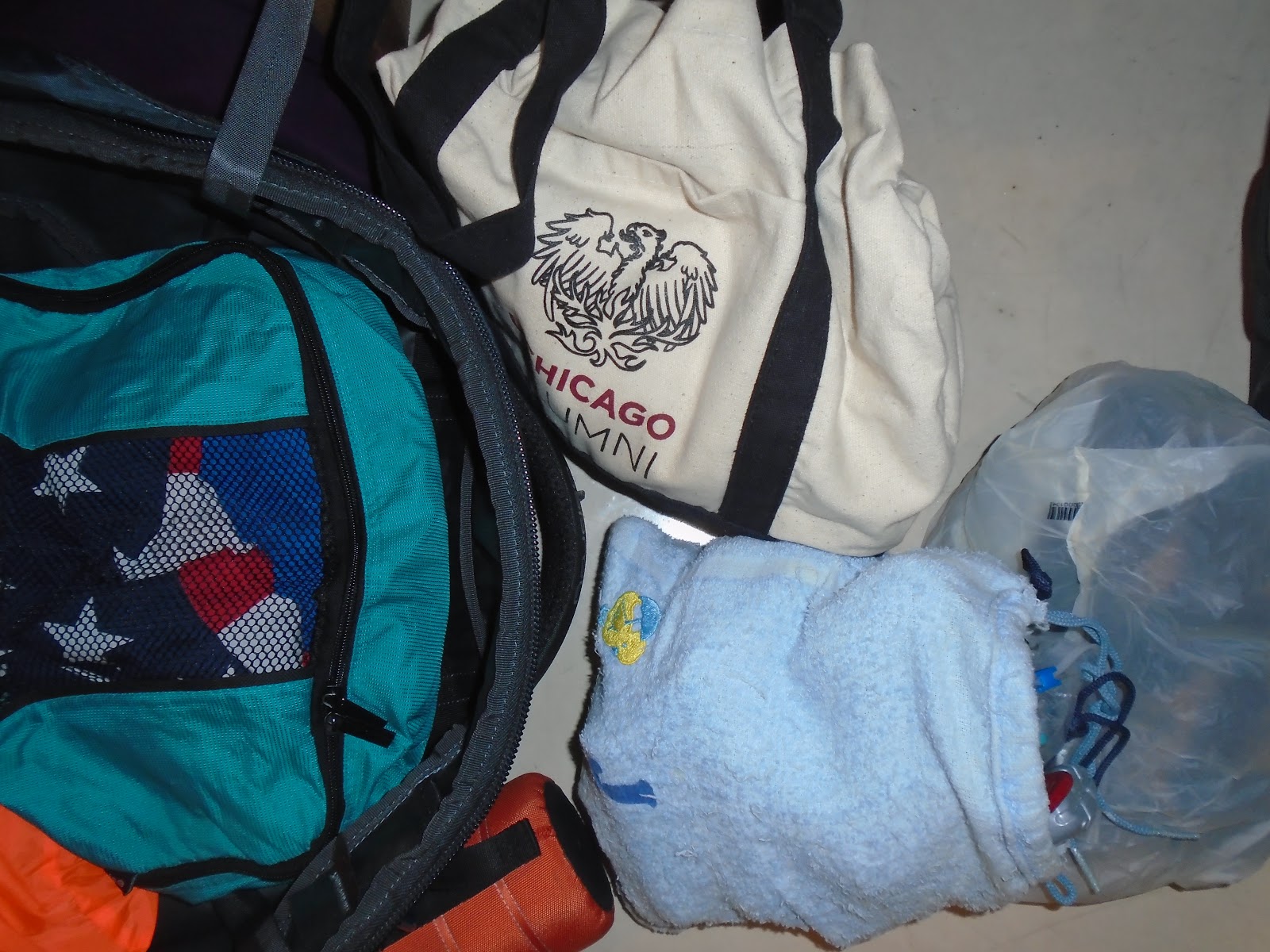
Here we have the main ingredients of the bag, i.e., clothing. The packing cube on the left contains pants/shorts--the only items I fold. The tote bag contains shirts (rolled up), bandanna, and swimsuit. The bath bag (with duck) contains all toiletries. Given that I don't wear makeup or take any prescription drugs, I still don't know why it's so full! Sunscreen and insect repellent? First aid?

The small orange stuff sack contains socks and what a British person once called "smalls." Oh, and the plastic bag contains my sandals. I tuck these in last thing at the top of the backpack, just before I lock it shut.

 The striped bag is for dirty laundry, to keep it separate from everything else in the backpack. The blue packing cube contains some small items that could otherwise be lost too easily: headlamp, portable charger, clothespins, shoelaces, necklace, batteries. This cube tucks in vertically between other items when I pack the backpack horizontally--it takes up so little room you can't even see it in the top picture.
  Tucked into the very bottom of the backpack is this memento of Barack Obama's first inauguration. This was the trip where I almost missed my flight to the U.S. (from Canada) because I was detained for carrying only a sweater in a plastic bag. I was only traveling for the day, but I guess it looked suspicious. So I bought this tote bag for my return from Washington, D.C.

It contains three things I don't need to get out every day. One is a pair of canvas sneakers that I occasionally use, e.g., to go to a gym. (They are also supposed to be acceptable footwear should we ever want to visit an upscale bar, etc., but T. only has her flip flops and hiking boots anyway!) The second is a bunch of small notebooks, which I'm gradually filling with notes from our travels and then mailing "home."


Last, and least frequently removed from the backpack, is a compression bag. When empty it looked like this:
 You put whatever items of clothing you don't need very often in here, squeeze all the air out through the valves at the bottom of the bag, and roll it up. In my case these are a few items of warm clothing that I won't need for months, but are too nice to get rid of. I expect to unpack them in Canada.


So much for the main backpack. Let's check out the bag I carry everywhere!
Decorated with souvenirs from every country (so I don't have to pack any)


 In this top zip compartment is a clip for a keyring, plus a couple of labeled Ziploc bags containing chargers and cords for everything. The duck also lives in here.

Normally this mesh pocket contains a water bottle. At Cape Town airport, the security guy questioned me because he couldn't see a South African flag on my bag! So I try to keep something clear in here. There's also a cross which a friend of T's gave us for our travels. It's not that we believe it has any magic powers, but people all over the world wear or carry symbols of their religion. I like this one.


The other mesh pocket contains my sunglasses and glasses case. There are cloths in here to clean glasses and, because I'm always wearing mine, a harmonica. You never know when I might feel like making music on the road.
The sunglasses are protected by my Australian Open "stubby holder," a foam thing handy for holding cold drinks.


The main compartment of the daypack contains whatever I need during the day. When we are in transit and I have to carry everything, this includes the portable hard drive used for backup, my passport and other essential travel documents (not pictured), and noise-canceling headphones. On a day out I would normally leave these locked up securely where we are staying. The bag also contains a phrase book (or in the case of Asia, Point It, which just has pictures you can point at); my journal for making notes; if necessary, a fleece in a water-resistant stuff sack (the soft inside turns out to form a travel pillow); and a blue travel cube with Ziplocs/plastic bags, which are always handy for keeping liquids separate and occasionally for airline security. Mobile phone and camera (not pictured). Oh, and books. I should really limit myself to one book because the bag would then be less full and heavy, but I have not been successful.

One more item that lives in my daypack in rainy places: a lightweight waterproof jacket (not pictured) that rolls up into its own pocket. When I'm in transit, it clips via a carabiner onto the outside of my backpack.


This last item looks like a Bible carrying case (if you grew up in evangelical country, you know what I'm talking about). It is actually a foil-lined bag that is supposed to keep food cool. It is useful to carry lunch/snacks separately, if we are traveling on a long-distance bus or train. On planes, I use this as a small handbag for anything I'm likely to use during the flight. Book, iPod, Ziploc with toiletries, etc. I always carry my eye mask and ear plugs with me on board--let's face it, I'm unlikely to sleep as it is. My travel mug can also live in here when it's not clipped to a carabiner on the outside of my bag!

So there you have it. How I travel light. And by light, I really mean (since my backpack is well designed, with comfortable waist straps) that the backpack is light enough to walk around carrying, with my hands free. It can squeeze under a bus seat or even onto my lap (think African minibus), and, provided the contents meet security requirements, into the carry-on compartment of a plane. In fact, the daypack even zips onto the backpack so I can carry it all at once, but I find that feature awkward. When I have to carry everything, it's easier for me to wear the daypack in front. Believe me, once you see enough people traveling around it won't feel weird anymore.

You'll notice I still have room for many items that are personal and make me feel at home wherever I go. Your approach should be personal as well; there is no "one size fits all."

I hope I can answer any questions so that you, too, can travel light--whether it's on vacation with only a carry-on, or around the world just doing laundry once a week.