Sunday, August 23, 2020

A Canterbury tale

Francis Bacon told the tale that “if the mountaine will not come to Mahomet, Mahomet will goe to the mountaine.” I’ve been thinking of the many Muslims around the world who had saved up, some for many years, to make that once-in-a-lifetime pilgrimage to Mecca called the hajj. But this year, for the first time in memory, the hajj was canceled. I can hardly imagine the loss and disappointment that many of those would-be pilgrims must feel.

We are very fortunate. We have not experienced anything like this loss, let alone the illness or economic hardship that countless other people in the world have suffered as a result of the COVID-19 pandemic. We’ve been blessed to travel so much in our lives already and, many times in 2020, we’ve thought how fortunate we were to be on the road in 2017-19 instead. I know of people whose travels and lives were disrupted, sometimes with great severity. And, perhaps like you, I know people whose loved ones have died of the disease.


So we know how fortunate we are. Here in England, we made it through several months of near-lockdown while carrying out our work (Trish never dreamed her part-time grocery store job would make her so “essential”). Though still far from the old normal, things are starting to open up now, and—here, at least—we’re cautiously optimistic that the curve remains flattened and the first wave under control.


Despite all this, I’m feeling deprived in the second half of 2020 in a way I didn’t during the spring. That’s because, apart from some activities and meeting with friends that everyone had to stop doing for a time, we really didn’t have plans disrupted during lockdown. We’d had a long-overdue catch-up with friends in Devon in February, and then in March everything kicked off. But we had no travel plans that month that we had to defer or cancel. Nor for April, May, June, or July. I don’t remember the last time we spent this long continuously in a single country, England or otherwise.


Our second half of the year, though, was not meant to be spent here. We were booked to spend a significant chunk of it in Toronto, which we so enjoyed in 2018-19. And of course, from there we were meant to visit family and friends in the U.S. We would also by now have expected to host my mom and dad on a visit from America, and, in an ordinary year, no doubt others as well.


But no one’s year is ordinary. None of those trips are happening, and for good reason. One of my aunt’s friends pointed out, wisely, that a pandemic on this scale is a once-in-a-century event and we should all just take a year off. Not, of course, that we can all afford to stop working or learning or taking care of our families, but we can’t expect anything to go back to normal this year, and we should probably stop trying. I suspect minimizing the disease and rushing to reopen things too soon have made things worse in some places than they had to be, but that’s not the subject of this post.


In the spirit of those Muslim pilgrims, I thought I’d make a pilgrimage of my own. Specifically, now that travel restrictions within the U.K. itself have been lifted, where have I never been in this country? Which is how Trish and I made our way to Canterbury, a site of pilgrimage at least since medieval times, as described in Geoffrey Chaucer’s Canterbury Tales.


For most of two years, we traveled around the world with only a 40L backpack and a day pack each. As we learned, the amount of stuff you need to carry for two years isn’t much more than what you need for a week. The funny thing now is, I pack the same bag for any length of trip. So now, packing for a two-day getaway, Trish said it looked like I was taking this enormous bag of stuff!


I was excited, though. We were going somewhere, doing something new, and that is not to be taken for granted in 2020. Although Canterbury is little over an hour’s drive from London, neither of us had ever been there, making it the first new place we’d been since Ecuador.


We weren’t going to be able to forget it was the plague year, though. A few days before, we’d run around our house in Twickenham shutting windows, because a tremendous hailstorm was throwing down; it made the national news. I wouldn’t have been at all surprised to see frogs or locusts next, but what in fact happened was that, as we drove closer to Canterbury, blinding sheets of rain would suddenly lash down and threaten to flood the road, only to stop as suddenly. The rain washed out our plans to take the riverside walk from our bed and breakfast—but at least we could stay in one. The staff had made many alterations to comply with government guidance on safety, and were obviously happy to have customers back. They asked if we were nervous about our first trip post-lockdown. We said we were not.


Breakfast room. From one particular seat, you can see the cathedral.

We’d assumed we would have to book meals out, like our visit to Canterbury Cathedral, in advance. Everyone has to be conscious of how many people are inside at one time, to maintain social distancing, as well as contact details in case of track and trace. So imagine our surprise when, venturing into town that evening, we discovered a street food fair was going on.


We love these things. It reminded us of many places we’ve eaten all over the world, though with obvious changes: entrance and exit, one-way signs, hand sanitizer everywhere, masks on the staff. If we’d known, we wouldn’t have bothered booking a restaurant.


The next day, the weather was forecast to hold until afternoon, so off we went on a 3 ½ mile hike I’d looked up in a big book of British walks. It was the first time we’d walked anywhere other than from our front door since March and, apart from a bit of a walk with our friends in Devon before lockdown, Trish’s and my first hike together since the Galápagos Islands. As she wrote many times in her own blog, Trish “isn’t a hiker,” but fortunately there wasn’t much climbing and it wasn’t too warm. Given the humidity, in fact, it was just as well the clouds persisted throughout the day.


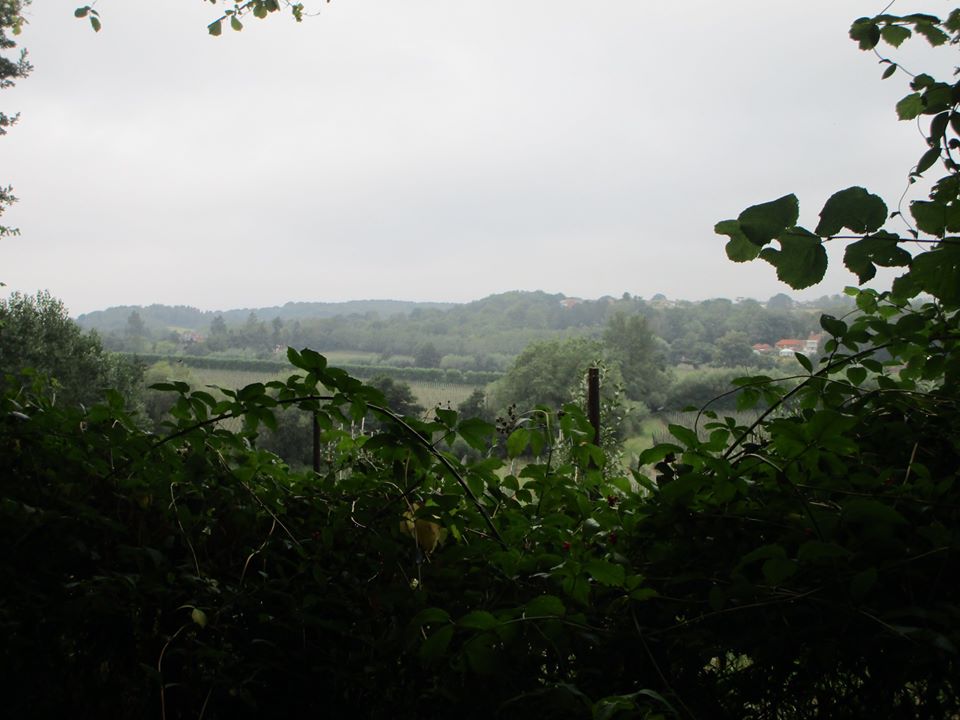
There were blackberries to pick and eat along the way, as we walked past the castle and up along part of the North Downs Way.


I thought we’d have more of a view from Golden Hill, whence pilgrims once caught their first glimpse of Canterbury, but we just came down the London Road and through Westgate—the same way we’d come in the car.
 

Trish arrives at Westgate

Proud of ourselves, we’d managed to miss the rain. We continued round to Northgate and outside the city walls before making our pre-booked time at the cathedral.


City walls

Canterbury Cathedral is the cathedral of the Archbishop of Canterbury, the leader of the Church of England, and thus the mother church of the worldwide Anglican Communion. Its origins, though, go many centuries back before there was any such thing, to A.D. 597. The cathedral we see now is 11th-century, with the east end in a 12th-century Gothic style to house the shrine of St. Thomas of Canterbury. It was this shrine that drew Chaucer’s and many other pilgrims. 


The interior, almost all to myself. Brilliant

Thomas à Becket, the Archbishop of Canterbury, had clashed with Henry II, to whom is attributed the exasperated saying, “Will no one rid me of this turbulent priest?” Eager followers of the king promptly murdered Thomas in the cathedral. To this day, Henry’s saying is a classic example of “Your wish is my command.” The ruler didn’t have to command his subordinates to rid him of the priest; they heard what they heard. This is why it's so dangerous for a powerful leader just to throw around irresponsible remarks.


The Pilgrims' Steps that led to the original shrine

Thomas à Becket has the distinction of being venerated as a saint in both the Catholic and Anglican traditions. Yet even in death, his conflict with the secular power continued; Henry VIII summoned him, without success, to face charges of treason in 1538, and when Thomas failed to appear, that was the end of the shrine. Today a candle burns on the original site.


There's also a shrine to saints and martyrs of our own time.


While I wandered around the crypt, Trish noted the scaffolding on the outside of the cathedral, where they’re noticeably cleaning it.


The gift shop sells teddy bears and rubber ducks dressed as archbishops. I don’t know if that’s weirder, or the fact this one was wearing a mask. 


It was also weird to have to wear a face covering in a house of worship, as has been required in England since they reopened for public services. I, myself, hadn’t been physically inside a church on a Sunday since March.


Afterwards, we were happy to see the street food fair was still going. We got some lunch, just before it started to rain again.


Social distancing, paper straws


Holed up in Canterbury, I reread some of Chaucer’s Tales and thought about what a privilege it is to travel, to go places and see other people. I hope I’ve never taken it for granted, but surely none of us will, after this year is over. Even before the pandemic, Trish and I remarked many times how glad we were to have done all that traveling before her health problems, before circumstances changed and some things became no longer possible. 


Some of the more colorful bohemian characters, real and imagined, have lives filled with love affairs, each in turn portrayed as the love of their life. I am that way about places. I remember the lift in my heart when the skyline of Chicago would come into view, knowing that I was going to live there. The love I felt in the botanical gardens at Oxford, my first foreign city in my first foreign country. Toronto is my adopted city; I always feel at home there. These are all places I found when I was young.


Some people say that middle-aged feelings are deeper and richer than young feelings. Either that’s not true, or I’m younger than it says on the paper. Middle-aged feelings are certainly different—the outlines less clear, the edges less sharp—but I don’t feel more deeply. Canterbury, the young man at the tea shop told us, wasn’t known as a student town when he was growing up there, but it is now. Perhaps for this reason, for me, it evokes Oxbridge. The punts on the River Stour.


Maybe on a better day

I’ve written before that my regrets are things I didn’t do (and one of those was not buying 9 doughnuts for a pound). If you get an opportunity and you want to do something, take it. Never defer an opportunity thinking you will do it another time. You may not.


When we came back to the parking lot, there was a couple struggling to make sense of the payment machine. Trish offered to help and we could see, from their language selection on the screen, that they were German speakers. After some struggling back to English we realized that they were trying to pay just after having arrived, whereas this was one of those automatic machines that reads your license plate and charges you when you leave. When I explained they seemed embarrassed about it, but it’s not obvious; I’d only dealt with this type of machine in one other place.


After the German-speaking couple left for their rainy afternoon in Canterbury, I realized what had just happened. Some visitors from another country—although for all I know, they live in Britain—had needed help in an unfamiliar city, and we’d helped them. The same thing that happened to us hundreds of times in the two years before COVID-19, across more than two dozen countries. I had missed that experience, being on either side of it. I hope to have it again.


  “This world nys but a thurghfare ful of wo,
                 And we been pilgrymes, passynge to and fro.


Sunday, May 31, 2020

Poems so far

In a previous post, I shared a poem introduced on Radio 4’s Today programme. BBC staff were taking turns reading poems that had meaning for them, a moment in my day that I also found helpful. 

A rare, clear view of Great Britain from the international space station
In turn, I started passing on poems to others in this world of quarantine. Many I heard on the radio, some new to me (like that first one), others well known. Some were shared with me by friends, and some are just among my favorites. Some resonated with a particular time during the lockdown: the psalm by Ian Sowton, a poet and fellow congregant at Holy Trinity, Toronto, was read during Holy Week*, while “For the Fallen” seemed appropriate for the 75th anniversary of Victory in Europe (VE Day).

Almost all of these poems are available publicly online. In a few cases, I have not included a link because the link I found did not actually get the words right, and I went by the book in my hand. It is not my intention to abridge anyone’s copyright here. If you also find poetry helpful in getting through tough times, and have the ability, I encourage you to buy books (preferably including some contemporary poets who could use the income) or make a contribution to the Poetry Foundation.

Quarantine comes from “forty” (days) and although these abnormal times are far from over, I now have forty poems. As people in various countries start to move, tentatively and (please God) safely, into whatever the future is going to look like, I hope some of these will move, entertain, or just connect you to others, as they have me.
1.     Sonnet 116 by William Shakespeare ["Let me not to the marriage of true minds"]
2.     "On Time" by Kahlil Gibran
3.     "These Are the Hands" by Michael Rosen 
4.     “Heavy” by Mary Oliver. This poem was sent to me by our lovely cousin Lezlee.


5. "Fern Hill" by Dylan Thomas
6. "The Stolen Orange" by Brian Patten
7. This poem was for the 250th birthday of William Wordsworth. It's from a special illustrated collection that my aunt Janet gave me in childhood. The illustrator is Krystyna Orska.

8.     "Endymion," Book I"  by John Keats [A thing of beauty is a joy for ever]
*9.   "Lazarus" by Ian Sowton


10. Sonnet 29 by Shakespeare [When, in disgrace with fortune and men's eyes]
11. "Return" by Mary Dorcey (b. 1950, Ireland). This is what my mom read at Trish's and my civil partnership ceremony.

At last, the train will lurch in,
twenty minutes past the hour, the
dark flesh of the hills, heaved behind 
before us, the narrowing fields,
the layered clouds, drifting
beyond us, lit for some other advent.
And everything will conspire
against me: luggage and children
crowding the aisle. A white-haired
woman, home from England,
Awkward with haste, will labour
her case to the door, her floral
print dress, a last check between me
and my first glimpse of you.
And there you are--by the turnstile
I will see you come through, though you
miss me; your brilliant eyes in flight
along the carriage windows.
You will wear your red, linen shirt,
the sleeves turned back, and snatched
From the hedges as you drove,
a swathe of flowers in your arms.
(Such a trail strewn behind us--a trail
of departures and pardons.) And my
blood will betray me--the old response,
I will hesitate, as if there might
still be time to change course,
or simply, not wanting to be caught
waiting for your gaze? The sky
will shift as I step out, a handful
Of sun thrust down on your hair.
On the narrow platform, our hips
will draw close, we will not mind
how they stare--the aggrieved faces--
such a fuss for a woman!
And in that moment, your laughter,
the heat of your neck at my mouth,
it will all be behind me again
I swear, as though coming home,
as though for the first time.

12. From "The Siege at Troy" read by Seamus Heaney
13. "The Darkling Thrush" by Thomas Hardy
14. "A Free Praise Song for the Pandemic" written and read by Christine Valters Paintner
15. "The Sun Rising" by John Donne. This poem was sent to me by our friend Kim in Australia.
16. "Yr Arwr/The Hero" by Hedd Wyn (b. Ellis Evans, d. 1917 at Passchendaele). In times this strange, we need a poem that contains both lilacs and a dragon.
17. "The Lake Isle of Innisfree" by William Butler Yeats
18. “You Bet Travel is Broadening” by Ogden Nash. One of my favorites. Incredibly, it was once possible to make a living as a poet in the U.S.A.


Doctors tell me that some people wonder who they are, they don't
know if they are Peter Pumpkin-eater or Priam,
But I know who I am. 
My identity is no mystery to unravel, 
Because I know who I am, especially when I travel. 
I am he whom the dear little old ladies who have left their pocketbooks on the bureau at home invariably approach,
And he whom the argumentative tippler oozes in beside though there are thirty empty seats in the coach. 
I am he who finds himself reading comics to somebody else's children while the harassed mother attends to the youngest's needs, 
Ending up with candy bar on the lapel of whose previously faultless
tweeds. 
I am he in the car full of students celebrating victory with instruments saxophonic and ukulelean,
And he who, speaking only English, is turned to for aid by the non-
English-speaking alien. 
I am he who, finding himself the occupant of one Pullman space that has been sold twice, next finds himself playing Santa,
Because it was sold the second time to an elderly invalid, so there is no question about who is going to sit in the washroom
Philadelphia to Atlanta. 
I guess I am he who if he had his own private car
Would be jockeyed into sharing the master bedroom with a man with a five-cent cigar.


19. "The Road Not Taken" by Robert Frost
20. "There Will Come Soft Rains [War Time]" by Sara Teasdale. I've loved this poem for more than thirty years, but it never sounded quite like it does now.
21. "Atlas" by U. A. Fanthorpe
22. "Adlestrop" by Edward Thomas
23. "This Is Just To Say" by William Carlos Williams 

24. "Quarantine" by Eavan Boland
25. "Praise the Rain" by Joy Harjo
26. To His Coy Mistress” by Andrew Marvell. This is an oldie, but I was reminded of it by a rabbi on the radio who paraphrased Marvell:"The laptop's a fine and private place/ But none, I think, do there embrace."
27. This is a song by the Indigo Girls. Written by Emily Saliers:


"All That We Let In"

Dust in our eyes our own boots kicked up
Heartsick we nurse along the way we picked up
You may not see it when it's sticking to your skin
But we're better off for all that we let in
We've lost friends and loved ones much too young
With so much promise and work left undone
When all that guards us is a single center line
And the brutal crossing over when it's time

Chorus:
Well, I don't know where it all begins
And I don't know where it all will end
We're better off for all that we let in

One day those toughies will be withered up and bent
The father son, the holy warriors and the president
With glory days of put up dukes for all the world to see
Beaten into submission in the name of the free
We're in an evolution, I have heard it said
And everyone's so busy now but do we move ahead
The planets hurling and atoms splitting
And a sweater for your love you sit there knitting

Well, I don't know where it all begins
And I don't know where it all will end
We're better off for all that we let in
You see those crosses on the side of the road
Or tied with ribbons in the median
They make me grateful I can go this mile
Lay me down at night and wake me up again

Kat writes a poem and she sticks it on my truck
We don't believe in war and we don't believe in luck
The birds were calling to her, what were they saying
As the gate blew open in the tops of the trees were swaying
I pass the cemetery, walk my dog down there
I read the names in stone and say a silent prayer
When I get home, you're cooking supper on the stove
And the greatest gift of life is to know love

Well, I don't know where it all begins
And I don't know where it all will end
We're better off for all that we let in

28. "A Pint of Plain is Your Only Man," also known as "The Workman's Friend," by Brian O'Nolan. I was once on a writers' pub crawl through Dublin, and the actors recited this. 


When things go wrong and will not come right,
Though you do the best you can,
When life looks black as the hour of night –
A pint of plain is your only man.
When money’s tight and hard to get
And your horse has also ran,
When all you have is a heap of debt –
A pint of plain is your only man.
When health is bad and your heart feels strange,
And your face is pale and wan,
When doctors say you need a change,
A pint of plain is your only man.
When food is scarce and your larder bare
And no rashers grease your pan,
When hunger grows as your meals are rare –
A pint of plain is your only man.

29. “On Nurses” by Roger Robinson


30.  More Mary Oliver: "Wild Geese"
31. “A Poem on Hope” by Wendell Berry
It is hard to have hope. It is harder as you grow old,
For hope must not depend on feeling good
And there is the dream of loneliness at absolute midnight.
You also have withdrawn belief in the present reality
Of the future, which surely will surprise us,
…And hope is harder when it cannot come by prediction
Any more than by wishing. But stop dithering.
The young ask the old to hope. What will you tell them?
Tell them at least what you say to yourself.
Because we have not made our lives to fit
Our places, the forests are ruined, the fields eroded,
The streams polluted, the mountains overturned. Hope
Then to belong to your place by your own knowledge
Of what it is that no other place is, and by
Your caring for it as you care for no other place, this
Place that you belong to though it is not yours,
For it was from the beginning and will be to the end
Belong to your place by knowledge of the others who are
Your neighbors in it: the old man, sick and poor,
Who comes like a heron to fish in the creek,
And the fish in the creek, and the heron who manlike
Fishes for the fish in the creek, and the birds who sing
In the trees in the silence of the fisherman
And the heron, and the trees that keep the land
They stand upon as we too must keep it, or die.
This knowledge cannot be taken from you by power
Or by wealth. It will stop your ears to the powerful
when they ask for your faith, and to the wealthy
when they ask for your land and your work.
Answer with knowledge of the others who are here
And how to be here with them. By this knowledge
Make the sense you need to make. By it stand
In the dignity of good sense, whatever may follow.
Speak to your fellow humans as your place
Has taught you to speak, as it has spoken to you.
Speak its dialect as your old compatriots spoke it
Before they had heard a radio. Speak
Publicly what cannot be taught or learned in public.
Listen privately, silently to the voices that rise up
From the pages of books and from your own heart.
Be still and listen to the voices that belong
To the streambanks and the trees and the open fields.
There are songs and sayings that belong to this place,
By which it speaks for itself and no other.
Found your hope, then, on the ground under your feet.
Your hope of Heaven, let it rest on the ground
Underfoot. Be it lighted by the light that falls
Freely upon it after the darkness of the nights
And the darkness of our ignorance and madness.
Let it be lighted also by the light that is within you,
Which is the light of imagination. By it you see
The likeness of people in other places to yourself
In your place. It lights invariably the need for care
Toward other people, other creatures, in other places
As you would ask them for care toward your place and you.

No place at last is better than the world. The world
Is no better than its places. Its places at last
Are no better than their people while their people
Continue in them. When the people make
Dark the light within them, the world darkens.

32. For the Fallen” by Laurence Binyon
33.  “[in Just]" by e e cummings

34. “Happiness” by Raymond Carver
35. This Lime-tree Bower my Prison” by Samuel Taylor Coleridge
36. "The Raven" by Edgar Allan Poe
37. "Siren Song" by Margaret Atwood
38.  Untitled" by Rainer Maria Rilke [Do you still remember: fallen stars]
39. “Atlantic Crossing” by Rod McKuen. Many years ago, Josh made a beautiful print of this poem for me on a watercolor background. It’s one of my most treasured objects from that time in my life. Now it sits on my desk and I look at it every day--same meaning, different time and place.
40. “The Point” by Kate Tempest