Thursday, September 13, 2018

Book review: Loaded: A Disarming History of the Second Amendment by Roxanne Dunbar-Ortiz

Every once in a while, I take time out to review a book that I think is worth sharing. For anyone who has ever tried to understand the gun violence in the U.S.A., Loaded should be required reading. You would not think a book on this topic would be a pleasure to read, but brilliant history is. Dunbar-Ortiz presents a vital perspective on what makes the U.S. such an outlier among Western developed nations. While Australia is often cited as a similar country with a history of gun ownership (and settler violence against the indigenous population), only the U.S. has the Second Amendment to its Constitution: “the right of the people to keep and bear Arms.” That is what keeps the U.S. from addressing its problem in the way Australians have theirs.

I knew Dunbar-Ortiz was onto something right away. She immediately dispels a myth cherished by many gun-control advocates: that the Second Amendment isn’t, or wasn’t intended to be, about the individual’s right to own guns. Clearly it was. Dunbar-Ortiz takes us on a compelling journey through colonial and U.S. history, from Daniel Boone, James Fenimore Cooper, and Jesse James to David Koresh, Timothy McVeigh, and contemporary mass shooters. Who, like gun owners in the U.S., are and have always been overwhelmingly male and mostly white.*

Like other readers who have already posted reviews, I was uncomfortable with Dunbar-Ortiz’s observations at many points. But her evidence is undeniable. Although her critique is from the left, Dunbar-Ortiz confounds expectations from the first page. She relates how, in the early 1970s, she was part of a women's group that took up arms for self-protection and, even though they did not believe in armed struggle, fell “under the spell” of guns. She compares this addictive pattern of behavior to other non-chemical addictions such as gambling or hoarding—then makes the all-important point that is too seldom heard: Only guns are designed to kill. “[W]hile nearly anything, including human hands, may be used to kill, only the gun is created [and marketed, and sold] for the specific purpose of killing a living creature.” (pp. 14-15)

Dunbar-Ortiz, of part Native heritage, grew up in a tenant farming family in Oklahoma. Her father and brothers’ hunting was their main source of meat, and she is not a critic of hunting. Rather, her argument is that “the right to bear arms” was never about hunting. This is so obvious when you look at U.S. culture, especially from the outside: Violence is such a pervasive and glorified part of our history. My family never had guns, even cap guns, but I nevertheless grew up imagining riding around with a gun as the way a hero behaved. Most movies and video games are U.S. in origin and so, naturally, are most violent ones.

Gun deaths are the most awful domestic manifestation of an exceptional culture of violence in the U.S. that is hard to deny. Of the 37,000 Americans shot to death in an average year, two-thirds are suicides, and of the remaining homicides about 1,000 are by policeI’ll give my own examples: Four U.S. heads of state have been shot to death, not to mention attempts and assassinations of many other public men. I have seen gun-rights advocates point out that there are at least ten countries in the world proportionally more violent than the U.S.A., including Yemen. Is that what we aspire to—not being Yemen?

The U.S. is and always has been a highly militaristic culture. No doubt other Western countries support their troops and honor their veterans, but in the U.S. this takes on a quasi-religious character; questioning the wars themselves means being unpatriotic. Dunbar-Ortiz shows how the Army of the United States evolved in the Indian Wars, with irregular settler fighters—armed civilians—in the vanguard. In parallel, U.S. policing developed along with slave patrols, civilian “militias” that rode around enforcing slave behavior at gunpoint. When we look at the killing and mass incarceration of black men today, it is not merely linked to slavery as in one more injustice against African Americans; it is baked into U.S. institutions.

Dunbar-Ortiz again surprises by resisting “racism” as an explanation for all this violence. Rather, she, and her evidence, show that the normalizing of violence, in “savage wars”** against “savages,” became part of what it meant to be a white American man. The colonists and settlers were armed to fight against indigenous people, whose land they were taking by force, and because the war was savage it meant noncombatants and food supplies (such as the buffalo) could be slaughtered routinely. The normalized violence became part of U.S. identity and so fueled race hatred, rather than originating from it. 

At this point, if not before, a white U.S. person like me tends to say “Hey, I agree that institutionalized violence was really bad, but I didn’t do it!” And we are right. No one living can be blamed for the genocide of Native peoples or for slavery, any more than young Germans can be blamed for the Holocaust, or young Cambodians for the Khmer Rouge. In an earlier book, An Indigenous Peoples’ History of the United States, Dunbar-Ortiz wrote: “The late Native historian Jack Forbes always stressed that while living persons are not responsible for what their ancestors did, they are responsible for the society they live in, which is a product of that past. Assuming this responsibility provides a means of survival and liberation.” But how do we do this?

Loaded is not prescriptive, although its author does make one recommendation: work for implementation of the International Arms Trade Treaty, to which the U.S. is a signatory. She does not think changing U.S. laws is a sufficient solution to gun violence. Something much more fundamental is required: to become a different type of society than we have been. I believe that this is possible for Americans to achieve (a leftist author might take exception to my exceptionalism here). But it will take a great deal more repentance, as in “turning again,” from violence and rapacity than our society currently seems to be interested in. Dunbar-Ortiz was raised Southern Baptist; she would know what I mean.

The only thing that stops me giving Loaded five stars is that it sometimes reads as if it was rushed into print. More than a few sentences really need a comma for clarity, if not a verb! These editing errors do not reflect flaws in Dunbar-Ortiz’s scholarship, but the book would be better without them.

Understanding what the Second Amendment was for means we can no longer look at it as a sacred part of the Constitution, but more like the three-fifths clause, the compromise around slavery that was eliminated from the Constitution along with the abomination itself. Gun-rights advocates are correct about the Second Amendment’s link to government tyranny—British tyranny over what Indian land colonists could or could not take. But most don’t admit, even to themselves, the white supremacist context of that link. As long as we continue to talk at cross purposes about the Second Amendment, about philosophy or hunting, the bodies of men, women, and children will continue to pile up, just as they have since colonial times.  


*Of Americans who owned guns as of 2013, 61% are white men, which is almost double their proportion of the U.S. population. 

**Max Boot, The Savage Wars of Peace: Small Wars and the Rise of American Power. New York: Basic Books, 2002.

Tuesday, September 11, 2018

Back on the bus, y'all

At the Greyhound station in Seattle, around 11:00 P.M., we were approached by a man I thought was a fellow passenger. He didn’t have a name tag or uniform that I could discern, but from his questions I guess he must have been a security guard: “Where are you going tonight? Spokane at 11:45?” It was clear, though he didn’t use this word, that he was checking to make sure we weren’t vagrants. If we had been, he’d have cleared us off the property.

I was vaguely proud that we were scruffy enough to be asked, with our backpacks and all. I had heard that Immigration and Customs Enforcement, or whichever branch of Fatherland Security is responsible for treating 100 miles from the U.S. border as “border cities,” was going onto buses and taking off people who didn’t have proper immigration documents. But I never saw any bus passenger even asked for I.D., and I don’t know if it’s just that someone like me would not be targeted. I’d like to think, if I were asked for my papers in “my own” country, I would stand up and complain, on behalf of those who have more to fear.

But the vagrant question points to another target. I didn’t get this phrase from my socialist magazine, I’m just calling it like I see it: Poverty is being criminalized. The more homeless people I saw on the streets of Portland or Seattle, the more I wondered how in the world they must live. By definition, homeless people have to do everything in public. Everything. Yet normal, natural things that we all have to do, like eat and rest, are increasingly banned in public places. If I sat on a bench and ate a banana or even fell asleep, I doubt a police officer would come over and stop me or move me along. But where are homeless people supposed to go?

I understand the bus stations, I really do. Customers should be able to use the bathroom without it being filled with people who live there. And nobody wants their sidewalk to be somebody else’s sewer. Yet poor people have the same needs you and I have. It’s one thing for the trail hikers to choose to sleep in a park. At least they have a choice.

Bummer, eh? Let me tell you, we were glad to get to Spokane! (And I finally confirmed that it’s pronounced Spok-AN, with a short a. You know, like Appalachia.) This is the home of T’s cousin Deirdre, Cuin and Cade’s mother, and her husband Brad, daughters Madeleine (Cade’s twin) and Jacqueline, son-in-law Chris, plus friends, dogs, cats, fish, and a horse called Huckleberry. You name it, it lives on their property. Even the deer are welcome there, although they’re legitimate objects of the hunt in other places.

Deirdre reckons it’s the Irish ancestry, but T’s relatives have ended up all over the world. In Deirdre’s case, she fell in love with an American. I have long thought that is an extremely risky thing to do, but she did and the rest, as they say…

Eastern Washington is a completely different landscape from the coast. Although it was too dark on the overnight bus to see it, as soon as you cross the Cascades you are in high desert. I was impressed by how much land there is out in the country where Deirdre lives, yet how close they are to Spokane. Before British fur traders arrived and set up a trading post, Spokane was long a crossroads for various indigenous nations, who met there to powwow and yes, trade.
That's Herbert Hoover, then Secretary of Commerce, with Alice Gary, great-granddaughter of Chief Spokane Garry, 1926. Picture in the Davenport Hotel
 One of the questions Jacqueline asked about our travels was if we had experienced any problems in different countries because of our relationship. Neither of us could think of any! Of course, this is The Discreet Traveler, and we make choices about which countries to visit and how discreet we need to be; but I couldn’t think of anywhere where we’d particularly had to hide, do the twin beds thing, etc. I did say I imagined a male couple would have a harder time, or at least would have to be more careful. As Cuca Hepburn wrote, I don't know whether it's because the revolution has been won or because people ignore women.

Chris took this picture of us.
The best thing about visiting relatives, besides being with people we know (or are getting to know), is home comfort. Deirdre and co. obliged with lots of good food, including an outing to Green Bluff, where we could pick our own peaches.

I’ve mentioned before that a perfect peach, as opposed to a mealy one you get in a supermarket, is just about my favorite food in the world. Along with peach ice cream, which is as good as it is rare. The peach ice cream we got at Beck’s Harvest House was almost as good as Ljubljana’s, possibly the best thing I’ve eaten on our travels.

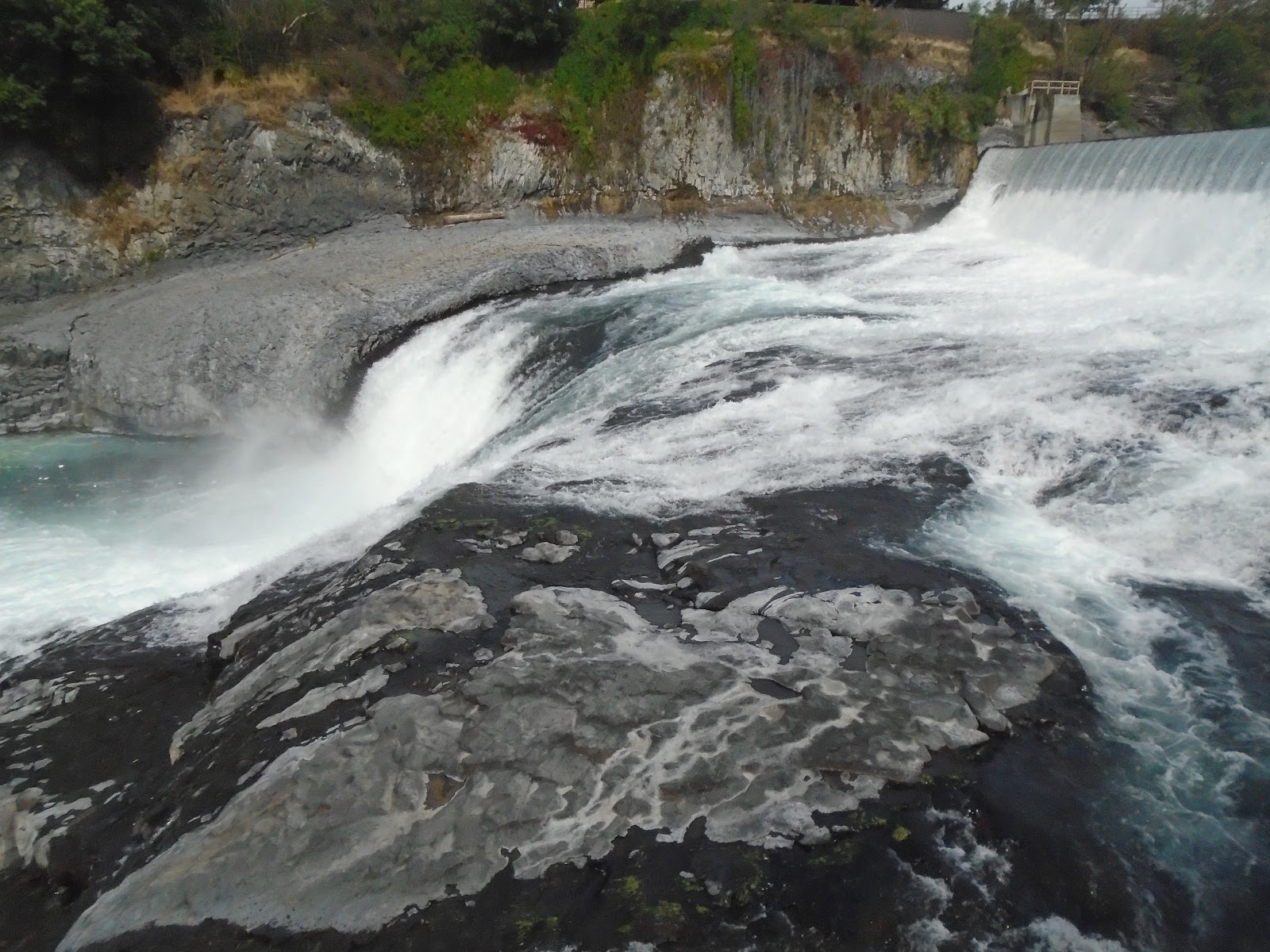
We also had a Thai lunch at a tiny place that just looked like it was built around someone’s home kitchen, followed by a visit to a state park. There’s a rifle range built on the edge of it, and I was glad I’d seen the sign, or the once familiar sound of shots ringing out might have startled me. The formation one can view here along the Spokane River is called the Bowl and Pitcher. See if you can pick them out.
Me either

Deirdre also took us around downtown Spokane one day. This is a city with a lot of churches. I know one can say that about any number of American towns, but really, there seemed to be a different denomination on every block, from Korean to Greek Orthodox. 

The river runs right through downtown, which means you can walk down and look at Spokane Falls from the central park.

Spokane also has a cool independent bookstore called Auntie’s, and you know I’m always up for those. Indeed, it was the prettiest downtown, with the healthiest looking mix of businesses, that I’d seen in quite a while. Deirdre also pointed out these signs, which we’d seen a lot of on the West Coast.

It kind of makes me sad that we live in a time when Americans feel they have to put up signs like this. Like the statement I once read about “open and accepting” signs at churches: “I thought everyone was welcome in a church.” But at least the signs are there.

The most famous son of Spokane was Bing Crosby. He was actually born in Tacoma, but grew up in Spokane and used to sing in the historic Davenport Hotel.
Hall of Doges
Photo: Deirdre Hansen
The Davenport is yet another example of a gorgeously preserved building saved from dereliction in the last century. It was once, and evidently still is, one of the grand hotels of the United States. I understand it is quite reasonably priced considering, but we had an even better deal at Deirdre’s.

It was amazingly sunny and warm while we were in Spokane, a pattern that would continue as we traveled north. Our final stop in town was Manito Park, which has lovely formal gardens. It also has a great collection of lilacs—a favorite of mine—but they’re not in bloom in August.

After pork chops, waffles with strawberries, roast beef dinner, homebaked soda bread, oatmeal with fresh peaches, plus all the stuff T. cooked while we were there, I guess I shouldn’t have been surprised when Deirdre offered to pack us lunch for the bus. I was surprised that she threw in Madeleine’s homemade chocolate chip cookies, too! The only thing we didn’t have while we were there was junk and alcohol. T. bought Doritos at a rest stop, and I can’t say anything about the other, because it is banned on Greyhound buses.

I mentioned the rest stop. It was at a place called Ritzville, which believe me, it wasn’t. They really need to work on their place names in Washington. We didn’t go, for example, to Potholes State Park, but I’m willing to bet it is nicer than Ritzville. Now who mixed these up?

The bus over to Everett took what might be called the scenic route. We stopped a couple of times to pick up hikers from the Pacific Crest Trail, for instance at Stevens Pass (4,061 feet). The bus crossed the Wenatchee River, wound its way through the Mt. Baker-Snoqualmie National Forest, and passed a state fair, with tents dedicated to Goat, Sheep, Swine, etc. Most of the scenery was fabulous.

In Everett we switched to our seventh and final bus of our West Coast journey, and the only one driven by a woman. I have to say Greyhound (and the affiliates it contracts to) was 7 for 7 in terms of decent journeys. Only this last bus to Vancouver was not on time, and that was understandable given rush hour traffic north of Seattle, plus the Canadian border at Blaine. In the event, we hardly had to wait at all to cross the border, and the Canadians were not concerned about T. even though our plan was to come back and spend several months in their country. I mean mine! We were asked what we did for work and the border official concluded that I am on kind of a sabbatical. I guess you could call it that.

I’ve never been to the western provinces of Canada, so British Columbia was like “coming home to a place I’d never been before” (as John Denver used to sing). Gastown seemed like a happening neighborhood although we didn’t have time to enjoy it. We were spending one night and, as Vancouver is another very expensive city, we spent it at the Cambie Hostel. A little less shiny than the H.I., but then they had a live band in the bar (and a bar for that matter), and a resident cat. 

We were so grateful for our cousins’ hospitality, especially as we’d never met most (or in my case, any) of them before. Americans, including those who have immigrated to the U.S., are a diverse people, and they’re also the salt of the earth. As happy as I was to arrive in Canada, we weren’t quite finished with the western United States. The biggest state of all was still to come.

At the Canadian border, Surrey, BC. Canada est toujours "ouvert"!

Friday, September 7, 2018

Portland and Seattle

Things I love about Portland: It’s so easy to use the public transit. When I recall Budapest, the difficulties we had around public transit made such a bad first impression that the rest of the city never really recovered for us. By contrast, in Portland I got on a bus and, without any advance preparation or going to a special place to buy a special card, was able to pay cash. (Money. It’s a thing, people.) The bus driver was most helpful, explaining that a day pass was exactly the same price as a round trip, but I could use it all day. 

And I already mentioned how over-the-top friendly Oregonians seem to be. Both bus drivers. The guy in the drugstore with a gray ponytail. The woman in the post office, who seemed overcome with pleasure in being able to serve me. Indeed, I was helped by everyone in Portland, or at least everyone was trying to help. At one bus stop, a woman started chatting so I asked her if the bus went to Forest Park.

“Yes it does,” she said, “but I wouldn’t go there if you paid me!” She warned that people going to Forest Park are always getting stabbed, and a friend of hers was so afraid of this happening to him that he left Forest Park as soon as he’d arrived. Well, for all I know this woman was on her way to the park to spend the day stabbing people. So I eschewed the wilder side and walked to sedate Washington Park instead.

Christina and her young son, Henry, were great hosts (her husband Robert was away so we weren’t able to meet him in person). We reminisced about our high school years, mainly me making sardonic remarks on the bus. (I suspect I am a bit wittier in Christina’s memory than in real life.) Because the weather was unusually hot for Portland—in the 90s F while we were there—Christina suggested the park, or the coast. But when I really wanted to spend the day exploring the city, she came up with recommendations for that too.

If one is a woman unafraid to shave her legs (how is this still a fear?), or if you are OK with nonconforming gender presentations, or clowns living next door, Portland is for you. And where else are you going to see a gray-ponytailed guy wearing a “Ross Perot ’92” T-shirt? I had a wonderful day. Once I’d sorted my errands with all the helpful people, I started walking through the Pearl District, where lots of warehouses have been turned into coffeeshops and so on. It’s probably even a nicer place to have coffee when the weather is more typical.
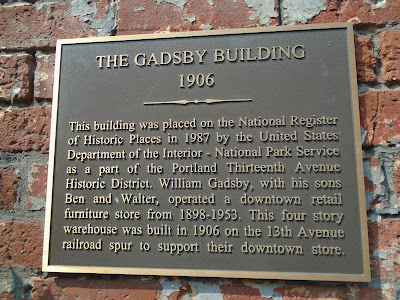
Barista, a nice place to have a coffee, is in this building.

The first shoe vending machine I have seen
Portland is divided into quadrants by Burnside Street running east to west and the Willamette River north to south. Northwest Portland is home to some gorgeous old apartment buildings. 

I used to live on Everett Avenue in Chicago, and when I saw a building called the Everett, I instantly wanted to move in. I kind of mean it. Portland is the first place we’ve been on these travels where I could imagine myself actually living. Not that it would happen; among other reasons, I’m tired of starting over and over in places where I don’t know anybody. But Portland just has that friendly, relaxed, you-can-bike-here-without-getting-killed vibe. Maybe it’s the legalized marijuana. We saw that advertised everywhere in Oregon and Washington.

Speaking of smoke, we hadn’t really noticed it, even though there were warnings about air quality and T. is asthmatic. I noticed when I walked up the Overlook Trail in Washington Park, though. Not because I smelled smoke or found the air difficult to breathe, but because when I got up the trail, I couldn’t see any mountains—not even nearby Mount Hood!

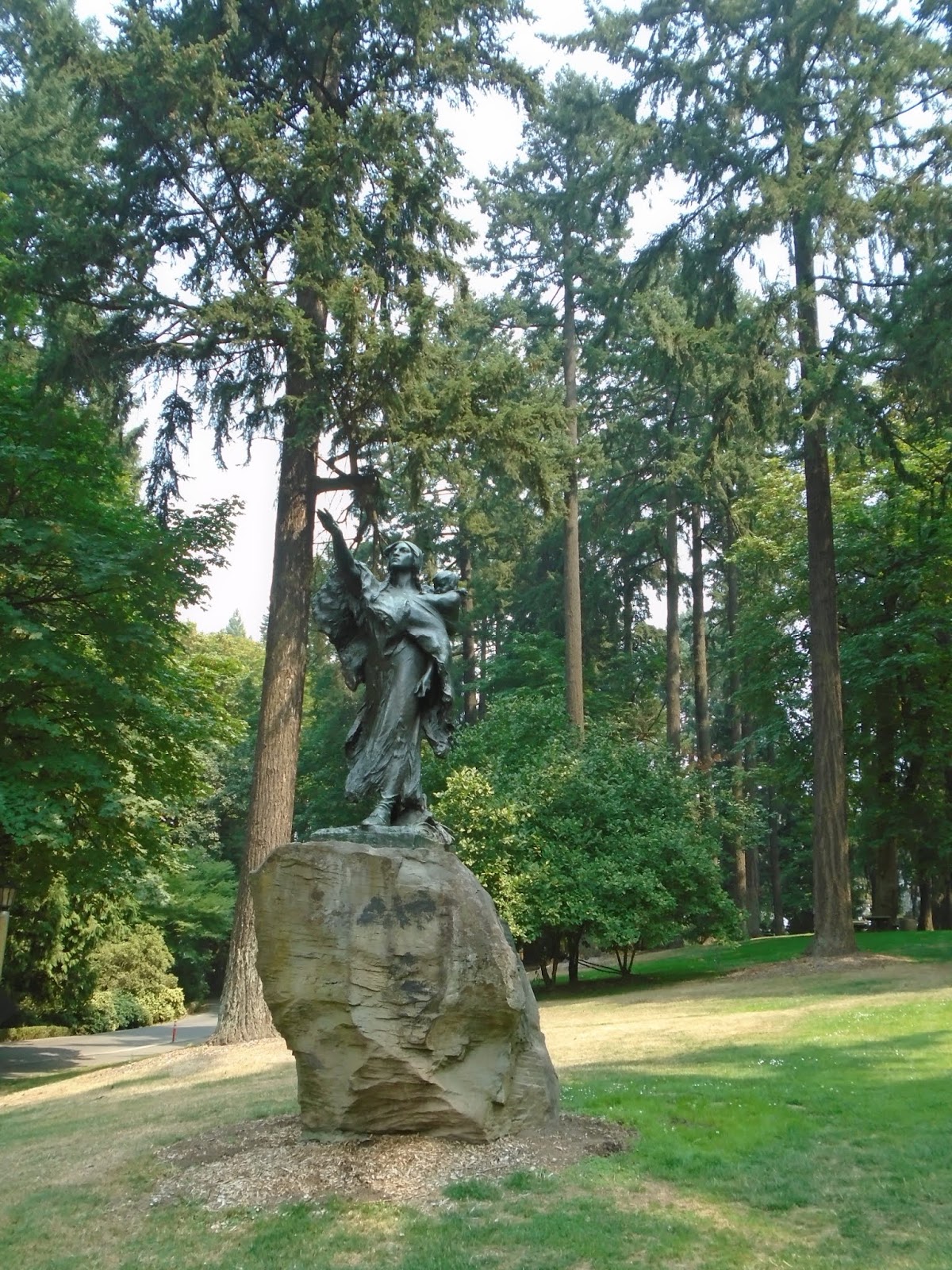
I did see some lovely trees, though, and an interesting statue which from a distance I guessed was a war memorial. In fact, these have been neatly reversed. Trees form a “living memorial” to Oregon’s Vietnam veterans, while the statue proved to be of Sacajawea, “the only woman in the Lewis and Clark expedition, and in honor of the pioneer mother of old Oregon.”


Portland is the City of Roses and this part of Washington Park shines in two exceptional ways. One is that it has a restroom free to all (most places in the city sternly warn NO PUBLIC RESTROOMS, lest a homeless person come in). And there’s a free shuttle to take you around the park. That’s in addition to the regular city buses.

The one must-see in Portland, Christina told me, is Powell’s City of Books. It’s been open since 1971 and takes up an entire city block. As a reader and writer, I’m a huge fan of independent bookstores and visit them wherever I can in the world. Powell’s was a joy to browse. 


I felt a tangible lifting of my spirits from being in such a great bookstore and seeing it filled with people and good books. There must be hope for America when so many people are reading so much thoughtful work, from Peggy Noonan to Ta-Nehisi Coates and from Shirley Jackson to Lawrence Ferlinghetti.

We had some great food in Portland too. Japanese with Christina and Henry, and then T. and I went out to a “fast casual” Indian called the Bollywood Theater. Fast casual is all the rage here apparently: you stand in line to order at the counter, they bring you your drinks, then you sit down and out comes good food. The only thing wrong with Portland was that we had so little time there. We’ll have to come back for some cooler, clearer weather. Watch out, Robert!
Sun through haze!
And so we were back on the Greyhound bus, bound for Seattle. As soon as we crossed the Columbia River, I noticed the Washington state highway signs. Most state highways are identified by a number in the middle of an outline like the shape of the state, but Washington State uses a profile of George Washington. (Utah used a beehive. A beehive is the Utah state symbol, apparently because of hard work.)

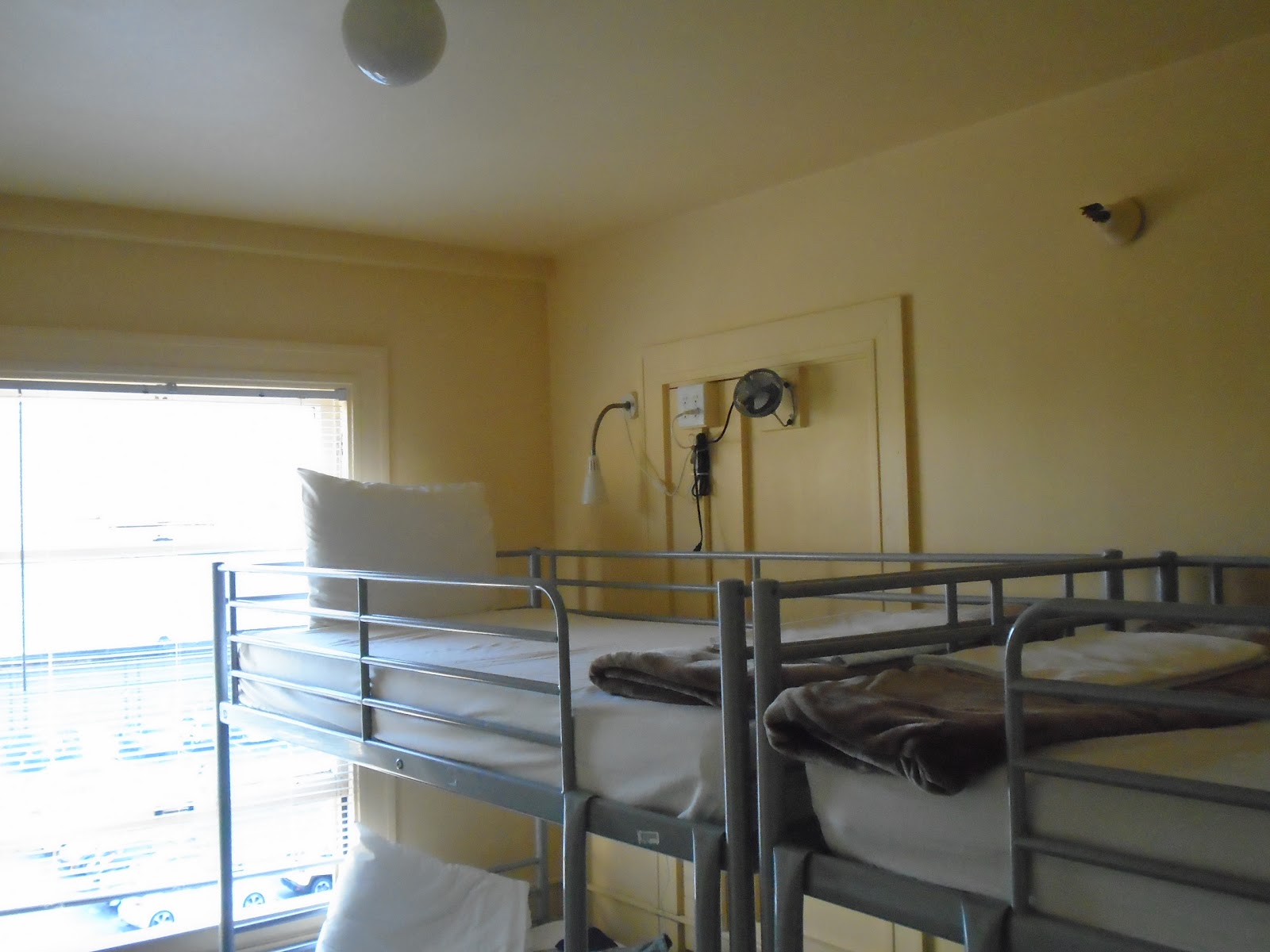
We landed at the Hostelling International hostel, the American Hotel, in Seattle’s international district. Like other West Coast cities, Seattle is expensive. T. was looking at accommodation and we figured a couple nights in bunk beds here or there was do-able. We were in a 4-bed (female) dorm and it was full every night. But it was a nice hostel,with individual power points and reading lights at each bunk, and breakfast and towels included. And we weren’t the oldest people staying there. There were Baby Boomers who reminded me of that couple we met in Bologna, who were celebrating their 65th and 70th birthdays and hostelling all around Europe.
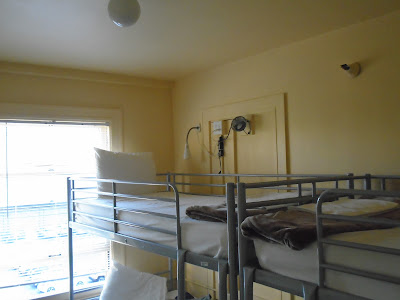
The thing about a hostel is that you meet people, and they tend to be friendly. One guy was biking everywhere and asked me if I was from Seattle. I told him I’d only just arrived and he said, “Oh, only I was hoping to find out if you can get a Greyhound bus from here.” Well, I could tell him that—we’d just walked from the station! He biked over there later and reported that he’d gotten it all figured out. I guess he’d take his bike on the bus.

The first place we went in Seattle, after dropping our bags, was the bar on the corner. It was a very local place, the type with a pool table and jukebox, Pabst Blue Ribbon signs and cheesesteaks. The latter were “very good” according to a man who, I later deduced, was Joe himself of “Eat at Joe’s.” It was uncanny to see the man in the portrait over the bar sitting on a stool at the end of it.

I love a place like Joe’s—almost as much as a big joyful bookstore. Seattle has one too: the Elliott Bay Book Company. It’s in Capitol Hill, called that for no reason I can determine, the heart of the LGBT community and apparently also nightlife. Browsing there, I came across an article by Rick Perlstein who, long ago, was a colleague of mine in the Editorial Collective of the Grey City Journal. Rick has become a historian of the Richard Nixon era and, as we know, it has been fifty years since 1968 when Nixon won the presidency. The magazine I bought contained reflections on the Democratic National Convention in Chicago that year, later assessed as a “police riot,” and to what extent it influenced the election. Given all the time we’ve spent thinking about Vietnam, I was ready for this.
Rainbow flags at all intersections, Capitol Hill

The Elliott Bay Book Company
But all the excitement around Seattle wasn’t intellectual. The hostel had a live local band in from 7:00 that evening, with free pizza, beer, wine, and even some bite-size brownies for everyone. What a deal! The band, Tupelo, was made up of Boomers, so older than most of the people in the audience (as are we). It was an appreciative audience, though, and the numbers grew as did the age range. Tupelo started with “Leaving On A Jet Plane” and continued with a wide variety of songs everyone seemed to know, along with some groovy, or poignant, originals. We don’t get much nightlife but for this, we didn’t even have to go outside!
Statue of Jimi Hendrix, Capitol Hill


Our daytime tour of Seattle started at Pike Place Market, where we enjoyed free samples of peaches and some lovely lemon cheesecake. You could eat all day at the market for the best prices outside the hostel. A young guy stopped us and asked about the patches on my daypack; he wanted recommendations of where to backpack in Europe. So we talked to him for a while about Ljubljana, Riga, and other favorites that are perhaps more discovered, like Berlin. The España patch drew attention later from someone working in a convenience store who sounded completely Americanized to me, but was originally from Uruguay. He had patches, too, but they were from volunteering with the peshmerga, the military forces of Iraqi Kurdistan! 

The obligatory symbol of Seattle is the Space Needle, built for the 1962 World’s Fair. It is not the tallest building in Seattle, though, so waiting for more than an hour to go up it did not seem like a good investment of either time or money. The Seattle Center, which also includes a glassworks exhibition by local sculptor Dale Chihuly, is reached via a monorail—all very futuristic in Jetsons terms.

We didn’t go in the Chihuly Garden either—it’s shockingly expensive. Most things in Seattle are; even the Pinball Museum, which might have interested T. with its vintage machines, charges $15. That’s a lot of money to pay for something that isn’t the Prado. Fortunately Seattle has some great things that are absolutely free, including walking around, seeing historic sites, and at least one museum. It’s run by the National Park Service and is part of the Klondike Gold Rush National Historical Park.
The Klondike River, which in 1897 was the mecca for any number of people most of whom never got rich (at least not finding gold), is in the Yukon Territory, in Canada. But through shrewd marketing Seattle positioned itself as the gateway city for journeys up the Inside Passage and into the Yukon. Thus, the free museum here. It has fascinating films and exhibits, especially about the diversity of people who ended up in the far north in those days. I never knew, for instance, that the original Klondike find was by two Native men, Keish “Skookum Jim” and Khaa Ghoox a.k.a. Dawson Charlie, and a white man, George Carmack, married to Keish’s sister Shaaw Tlaa.

It all ended badly for the woman, as things so often have. George Carmack left Kate, as he called her, and remarried in the Lower 48, the U.S. not recognizing his marriage to a Native woman. Kate Carmack was unsuccessful at recovering any of the fortune her husband and brother had found.

There was also some interesting stuff about the “Buffalo Soldiers,” black troops who were sent to keep order in the lawless north, despite prejudice against them. It is thought that these soldiers’ nickname was given to them for bravery by some Cheyenne, who revered the buffalo.

You are never far from indigenous history in the Pacific Northwest. A Chinook artist, Duane Pasco, carved the totem poles that decorate Occidental Park, in Pioneer Square.

Pioneer Square is the oldest part of Seattle, which only means post-1889, when a fire destroyed many blocks of the city. Most of this neighborhood was rebuilt in Richardsonian Romanesque style, which means lots of pretty red brick buildings. These, along with the original Skid Row (logs used to skid down the street to Yesler’s mill before hard times fell on the lumber industry), were preserved by public effort from demolition in—you guessed it—the 1960s.
Smith Tower (1914), until 1931 the tallest building west of the Mississippi
We were walking around trying to get access to the waterfront. Entirely by accident, on a rather insalubrious side street, we came across a historical sign at the former site of a disco called Shelly’s Leg.

The eponymous Shelly Rauman lost her leg in a freak accident and, with the money she got in compensation, opened a gay disco in 1973. Most gay bars of the time were refuges hidden away in dark places, but Shelly’s Leg (I love her sense of humor) was bright and celebratory. Eventually it burned down, and the scene has moved on from Pioneer Square. But Shelly’s Leg set the tone for an open and inclusive culture still associated with Seattle today.

We wound up back in the international district where we were staying. Seattle’s Japanese community has long been large enough to constitute a Japantown. Before World War II, this community thrived with businesses like a teahouse in the historic Panama Hotel. 

The forced internment of Japanese-Americans after 1941 was a source of great trauma here. Many people felt that obeying without resistance, however unfair, would show their loyalty to the U.S. Some of them had sons in the U.S. military, who served with distinction. After the war the internment period was never talked about in some families. It was not until the third generation that people began to question and speak up about what had happened to their community.

I wanted to go up to the top of the Columbia Center downtown, which is taller than the Space Needle. It was $22, though, and there was a sign warning of low visibility (because of the smoke we could not escape). Once again, I did not take out my wallet. Instead, we decided to get a beer, something that is supposed to be available everywhere in Seattle. Buying it turned out to be remarkably challenging. The first place only took cards—no, thank you. The second place would not let us in without I.D., which I normally would have had with me, but we didn’t feel like producing at our age. Third time lucky. The bar was a dive and playing grunge music so loudly we couldn’t talk at all, but at least it sold lager! All the local brews taste like India Pale Ales to me, whether labeled IPA or not. Too hoppy.
I liked Seattle. It’s the kind of place I overhear conversations I want to be part of. At Henry’s Taiwan, where we had lunch, we sat next to three women who were talking about the Narnia books, the writer Nicola Griffith, and all-women spaces in the ’80s. Back at the hostel, waiting for our night bus, there were a few young people sitting near us who had been through-hiking the Pacific Crest Trail, until a detour (fire!) truncated their hike. The woman, who spoke English with what sounded like a German accent to me, turned out to be Italian but to live in Austria. She’d been working for Medicines sans Frontieres in Myanmar, but all the violence she was dealing with in the Rohingya genocide had burned her out, so she’d just decided to hike the PCT. I eventually did join in their conversation because I’ve always wanted to through-hike the Appalachian Trail. When I pronounced it Appalatchian, with a short a, the guy asked me where I was from; and when I said Tennessee originally, he said he was from Knoxville! He’d hiked the AT himself five years ago.

Tai Tung has been going since 1935.
It was really interesting to talk to them, but we had to move on. The hostel was full that night so the hikers were just going to sleep in a park somewhere. I guess, if you’ve chosen to live in the outdoors for months, that might not be such a big deal. We had a much more pleasant evening ahead, meeting T’s cousin Cuin at the oldest Chinese restaurant in Seattle.

Cuin is her cousin Deirdre’s son. We’d already met his brother, Cade, in Yellowstone, but this was not our first time meeting Cuin. He and his girlfriend Courtney stayed with us for a while on their trip to Europe a few years ago. It was great to end our Seattle trip with a visit to family and, yes, another pint at Joe’s.


Tuesday, August 28, 2018

Summer of love: San Francisco to Portland

When I was in junior high school, a teacher made some remark about boys dancing with boys: "Maybe in San Francisco," she said disparagingly. I didn't know anything about San Francisco, but I wanted to go to this place, where such queer things were possible. This was my first real visit--as an adult--and I loved San Francisco. I don’t know how anyone can actually afford to live there, but then, I’ve only been able to live in London because I got a lucky break. For the few days we were in San Francisco, I loved it. Though not as much as Portland, where we spent even less time.

The bus pulled into San Francisco around 7:00 in the morning. The new terminal is still being worked on, so there are no facilities there—not even a bathroom. (More so than on previous visits to America, I was discovering the scarcity of public bathrooms, all in an attempt to exclude non-customers.) Luckily, our Airbnb had a locker downstairs in the kitchen, so we schlepped our backpacks over there and locked them up. Then it was off to the cable cars.

San Francisco’s cable cars (not “trolleys”) are the last manually operated system of their kind in the world. Like so many other iconic things in the U.S., they were slated for demolition, but as long ago as 1947 a woman named Friedel Klussmann organized citizens’ opposition and saved the cable cars. She used facts—the revenue from this unique attraction was more than the cost of upkeep. Today the Hyde Street cable car turnaround near Fisherman’s Wharf is named after Klussmann, and when she died in 1986, cable cars across San Francisco were decorated with black.

My impressions of 1970s San Francisco, the mecca of gay liberation before AIDS, are shaped by Armistead Maupin’s Tales of the City. His characters rode the cable cars as transportation, but today, most riders are visitors rather than San Franciscans—certainly on the Powell-Hyde line. The wooden platform on which the operators turn the cars around by hand is something to see. We had all day so were happy to wait in line for our ride.

Every time the brakeman clanged his bell, I expected to see Maupin’s characters or those from the movie What’s Up, Doc? That’s the kind of city San Francisco is: we feel we know it because we’ve seen it so many times before. I was glad to be riding rather than walking up Nob Hill, though impressed that, now as a century ago, the cable cars were up to the task. A lot of Nob Hill did not fare as well when the earthquake struck. And this was just one of the times San Francisco has been faced with destruction; in the 1950s plans were made to crisscross the entire city with freeways, changing its neighborhoods beyond recognition. It will not be a total surprise by now that in this California city, citizens revolted at the plan, and were successful in organizing public transit instead. There is actually a statue in honor of the Freeway Revolt. 

One thing we all know about the Bay Area is that it is foggy. The fog had cleared by afternoon, though, so we got off the cable car at Fisherman’s Wharf and got some clam chowder with sourdough bread. Fisherman's Wharf and Chinatown are the only places I remember visiting the one time my family came to San Francisco, when I was fourteen. I remember Mom hustling us across what now seems quite sedate for a city street, saying that we should have Tennessee license plates hanging around our necks, to warn people what “rubes” we were. You can imagine how rice wine for sale in Chinatown blew my mind later that same day. I don’t think I’d ever even seen alcohol for sale, let alone something Chinese.

The next hill, we had to get up under our own power. This was the block of Lombard Street famous for its switchbacks—and flowers. Amazingly, they still let people drive down it.

We were ready to get back and check into our Airbnb. Next door there was a Pakistani-Indian restaurant. It was loud and clattery, no ambience whatsoever, but it was also full and cheery. The guy took our order and cooked our food right within view. It was wonderful, and cheap as far as San Francisco goes. BYOB. 

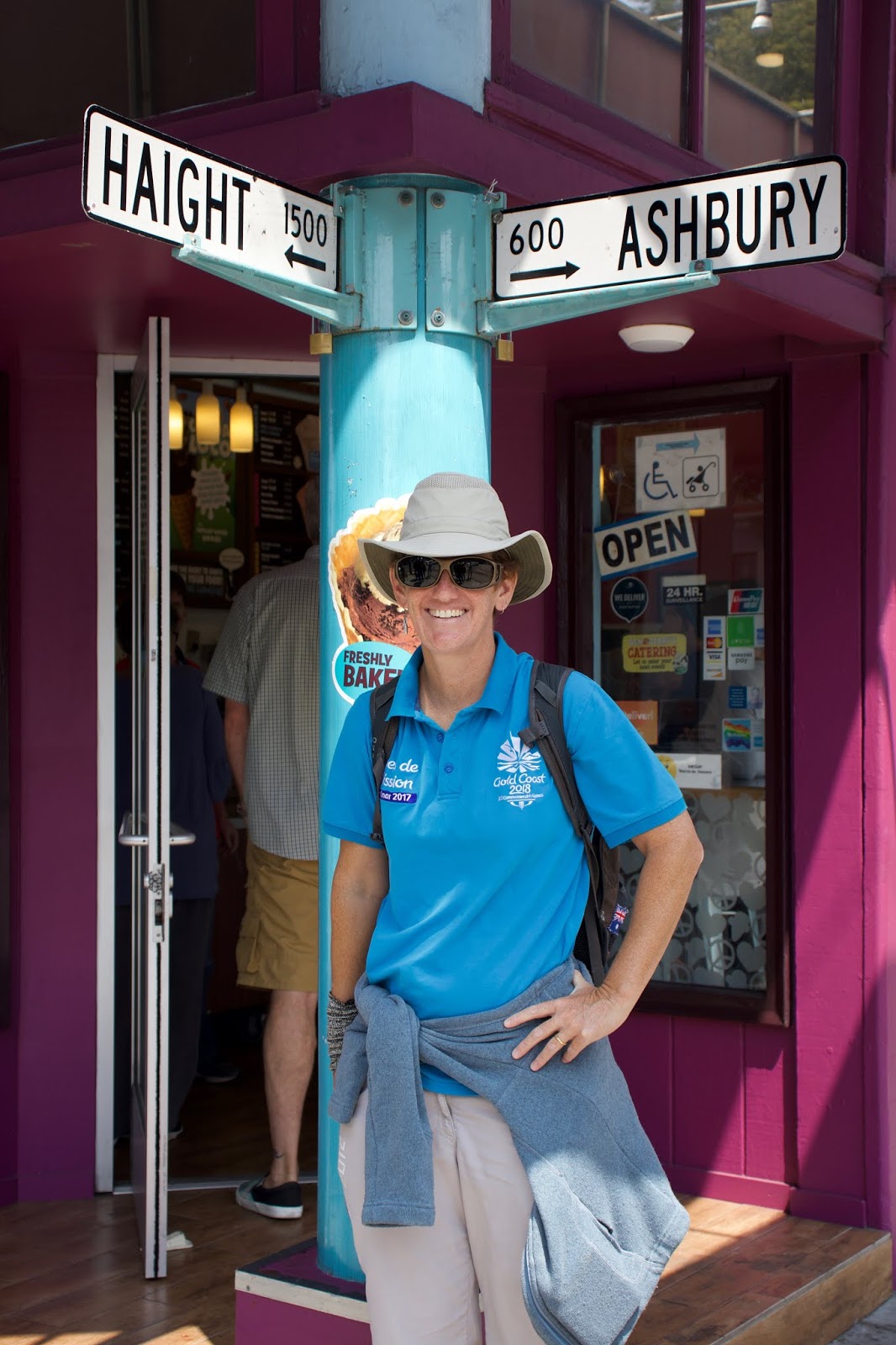
The next day was quite warm, so we risked sandals to walk around in. I think it was for this reason that the Hare Krishna at the corner of Haight and Ashbury thought we’d be into meditation and vegetarianism. He was not uninteresting to talk to, so I did. It’s not every day you meet a Swiss Hare Krishna. Well, maybe in Haight-Ashbury it is.

This is the neighborhood where you can still see a Jerry Garcia mural on a wall and Janis Joplin souvenirs in the window. The Summer of Love was so brief, and yet I had to visit this iconic area, because it’s part of the national consciousness—at least for me. My parents were about to celebrate fifty years of marriage and although they weren’t hippies, they passed on to me a love for some great music of that era. Not to mention the records themselves.

Our day of walking, which ended at Golden Gate Park, had begun at San Francisco City Hall. 
City Hall, with Zak Ové's sculpture Black and Blue in foreground
It’s awfully grand—looks more like a state capitol building to me. We were there because I’d read there’s a statue of Harvey Milk under the rotunda, but it was a weekend and City Hall was closed. So we went down to another iconic neighborhood, the Castro, where there are memorials to Milk everywhere.

If you haven’t seen the Sean Penn movie and don’t know the story of Harvey Milk, you can do no better than to read Randy Shilts’s The Mayor of Castro Street. That is how Milk styled himself. He wasn’t the first or only openly gay politician in the world, but what he told gay and bisexual Americans was that we must come out. That being our authentic selves, in front of our families, our neighbors, the people we buy from or work with, was important and would make a difference. Milk was assassinated along with Mayor George Moscone in 1978, having served less than a year as a city supervisor, but he was prophetic. The speed with which attitudes have changed in the U.S. can be plotted along a direct line: from fewer than 25% of people saying they personally knew a lesbian or gay man in 1985, to more than 75% saying yes by 2013. 

So I had to have a drink in the Castro, once we found a bar with a mixed clientele. People watching is as much fun there as anywhere. 

The Castro Street neighborhood is adjacent to the Mission District, San Francisco’s oldest, so we walked there too. I was impressed by the size of the Women’s Building and the fact that it is still so busy offering services, nearly forty years on. 
Mural, Women's Building
By contrast, T. thought it was kind of sad that there’s still a need for those services. 


Between that and the relentless poverty, she was getting a little depressed by San Francisco. Luckily there was a food truck nearby. Food trucks are legendary on the West Coast, appearing first here, then on another street corner, and offering some of the best (and least expensive) food in the city. We were almost put off by the fact that they took no cash, only cards! But the sisig, a Filipino meat made into tacos, looked and smelled so good that we made an exception.

The Mission San Francisco de Asís itself is the oldest building still standing in the city, and dates from 1791. Much of the construction was done by conscripted local Natives, Ohlone and Miwok, who died en masse in measles epidemics. More than five thousand are thought to be buried in the graveyard, where there is a belated memorial to them. More positively, there is an affirming synagogue around the corner in the Mission. 
Sha'ar Zahav in Hebrew means "Golden Gate."
Nearby Dolores Park has—you guessed it—a hill, with good views of downtown San Francisco.


The next day T. wanted to visit Sausalito, on the north side of the Bay. I think it was more about getting out of San Francisco than any particular reason to go to Sausalito, but the real attraction for her was the possibility of biking there. Once again, she got me on a bicycle, and we made our way (gingerly, in my case) to the waterfront bike path and over the Golden Gate Bridge.


It was worth doing. Even into Sausalito was mostly downhill—so downhill that I’m afraid I never really let the bike go, because there were constant warning signs to go slow. (By the way, what’s happened to adverbs? Is slowly no longer a word used in American English?) We got a wonderful Mexican lunch (vegetable tostada with Dungeness crab and shrimp) and, when we’d walked around a bit on our sore legs, stood in line for the ferry back to San Francisco. This was where T. pined for the efficiency of the slow boat in Laos, where loading and unloading were as fast as anywhere else in Asia. On this ferry, all the bikes just went in an enormous pile, and many of the passengers seemed to have no idea how to walk a bike without entangling themselves with others. Also, they would not stop ringing the bicycle bells! T. said maybe they had special needs but I think that’s giving them too much credit. What they needed was not to be jerks.

We’d gotten 3-day transit passes which were very convenient, if only because we didn’t have to think before jumping on another bus or streetcar. San Francisco has streetcars like Toronto, distinct from the cable cars. In fact, one of the old cars I spotted was still branded TTC: the Toronto Transit Commission.

Despite the novelty of Chinatowns having worn off, we still had to stop there. We never did see Barbra Streisand or Ryan O’Neal from What’s Up, Doc? but we did see a Chinese dragon, or at least a head. We followed the sound of drums and found a band playing. Then we got some nice food, a heck of a lot cheaper than in Las Vegas!

We were next bound for Oregon, and T. had decided that this particular leg of our trip was best done in a rental car. For one thing, she wanted to drive more of winding Highway 1 along the California coast. Almost immediately there was a detour up Mount Tomales. At least, I think that’s what it was called. The fog closed in so thickly we were lucky we could see the road.

We rejoined State Route 1 near the Point Reyes National Seashore, where we’d been hiking with Bernie in July. One thing I noticed all along State Route 1 was that every town, no matter how small, had a post office prominently next to the highway. I went in the one in Tomales and was glad I did—the postmistress was so friendly, and the mailboxes hadn’t been updated in years.


Another thing I noticed was the interesting place names: Havens Heck Drive, Nameless Lane, Confusion Hill, Rogue C. College, Butcherknife Creek Road. Probably the funniest was a restaurant called the Smoking Duck, which was just a charred ruin. It had burned to the ground. Oops.

We soon realized that as scenic as Highway 1 is, it would take us a lot longer than T. had thought to get to Portland that way. But the next chance to cross over to U.S. 101 was not for another hundred miles! So we kept trying to enjoy the endless hills and sharp curves. The thermometer in the car would read 91 degrees Fahrenheit and then, an hour later, 61 F.

As we got closer to the Oregon state line we started to see redwood trees. The highways join at a tiny town called Leggett, which advertised the world famous drive-through tree. I hadn’t thought you could still do this, but since it was there, we had to.
T. was just impressed that as long ago as the 1920s, people had cut a hole through the tree without killing it. But if you thought this was kitschy, the “world famous” attractions were coming thick and fast. We quickly passed the chainsaw sculptures and various other mysteriously named trees, and even Heaven on Earth (whose cinnamon rolls were only “famous,” not world famous). 


T. for scale!
Nothing, however, could detract from the grandeur of Humboldt Redwoods State Park. It’s free and you can drive an alternate route to 101 along the Avenue of the Giants. This park contains some of California’s oldest trees, and more than half of the 100 tallest trees in the world. 


We had to stop often, but of course this made our day’s drive even longer. By the time we pressed on towards Crescent City, the redwood forest was dark. I think we were too tired to enjoy this stop for the night. All the kitchens in town except Denny’s were closed by 9:00 PM, and, chilly and disoriented, I couldn’t find the extra blanket that I knew the Super 8 motel room must have. Only in the morning as we were packing up did I find it. And breakfast was included, so it’s not Super 8’s fault that I didn’t enjoy it!

The next day we reached Oregon. With a single exception, everyone I talked to or interacted with in this new state was exceptionally friendly. It can't have been a coincidence. The guy pumping our gas (you can’t pump your own gas in Oregon). The woman in the sandwich shop chatted and wanted to know how we were doing—not in that standard empty way, but as if she really wanted to talk. It was from her that I learned what we probably should have known before we went to Oregon: that there were 500 fires burning across the state. A thick haze of smoke hung in the sky. We didn’t notice it by smell; maybe we’ve just gotten used to breathing bad air. But in the Pacific Northwest, they must be used to clean, clear air.

Oregon doesn’t have sales tax either. Maybe that’s why people are so happy there. You see a price on a price tag, and that’s actually what you pay at the counter—just like England. I enjoyed the novelty of paying round amounts, like three dollars or $1.75.

We went to Portland at the invitation of my friend, Christina. When I say “my friend,” I mean a girl I hadn’t seen since high school. Through the wonders of social media, Christina, whose father's ministry briefly overlapped my family going to their church, got in touch and asked if T. and I were coming to Portland. Then she said her family would be happy to put us up for a couple of nights.

Well, you know what happens when people say that to us. Next thing we were at her front door in the City of Roses. 

How much I enjoyed Portland will be the subject of my next post.