Thursday, October 26, 2017

The King and I...

We arrived at Mauritius airport for our flight to Bangkok. There was an interesting assortment of shops, including one with a person-sized stuffed dodo, a Happy Diwali sign, and a model ship. We were sorry to be leaving the heavily Indian-influenced island just before the festival of Diwali. What we didn’t realize was that in Thailand, our destination, the late king’s funeral was this month. 

Sure, I could have looked this up. I remembered that the king had died last year, but I wasn’t aware of how long the period of official mourning, as declared by the military government, would be.

I had some trepidation about traveling to Thailand on a one-way ticket. In South Africa, the airline official had insisted on seeing our onward plane tickets out of Mauritius, before letting us board our flight there. Officially, many countries’ immigration departments insist that you have a ticket out of the country before they will let you in, but in practice a one-way flight is usually okay (the immigration officers just need to be satisfied that you have the means to move on and aren’t planning to stay in their country illegally). The problem arises when the airline you fly out with wants proof that they won’t be liable for flying you back.

We don’t know when or how we’re leaving Thailand, so we had nothing to show the airline officer in Mauritius. Fortunately, all she did was ask us to promise that if the Thai authorities insisted we buy a ticket out of the country on the spot, we would do so, and her airline wouldn’t be liable! I thought that was pretty laid back of her. When we actually arrived in Bangkok, the Thai immigration officer who stamped us in asked us exactly zero questions, so entering on a one-way ticket was a total breeze.

On our ride in from the airport I was distracted by our taxi driver. The first one we got had never heard of our hotel (this has become a theme across the world) and couldn’t figure out where it was, so we didn’t leave the airport with him. The second one, it quickly became apparent, had a series of tics that caused him to cough, bang his head into the headrest (he had a special cushion for this purpose, I noticed), and various other things. Since none of them seemed to interfere with his driving—remarkably smooth for a taxi driver, in fact—I just relaxed and let him get on with it. It was like being driven by Rafael Nadal. Then I started seeing portrait after portrait of the late king, decked with marigolds.

King Bhumibol Adulyadej (the Great, Rama IX) was beloved of Thais. It is illegal to insult royalty in this country, but I don’t think that explains the reverence we are seeing. Until his death, King Bhumibol was the longest-reigning monarch in the world; most Thai people have no memory of any other king. Furthermore, although Thailand has been a constitutional monarchy since 1932, it has been a rough road in terms of democracy. Only one prime minister has fully served out his or her term. Under these circumstances, the occasional intervention of King Bhumibol behind the scenes (even though he had no formal government role) has probably given Thais some sense of stability.

This is my favorite picture of His Majesty, on a trip to the U.S.A.--the country in which he was born.
King Bhumibol of Thailand and Benny Goodman playing the clarinet, New York City, 1960
He played the saxophone too.

Ironically, there is no live music for the entire month of October. The funeral lasts for five days. We have noticed black-and-white bunting and marigolds, both real and artificial, everywhere, as well as portraits of the late king and Thai flags at half mast. What has been most striking, though, is the way individual Thais we have spoken to have referred to “my king.” When we acknowledge that we’ve heard the news and mention his death with respect, we get deep bows of thanks, on behalf of “my king.”

Royalty is very bound up with religion in Thailand and a lot of the sights we have seen are Buddhist temples/ruins. I have a very limited knowledge of Buddhism, but what becomes apparent if you travel outside Europe and North America is that most people on earth are religious. They may practice their religion in ways that are foreign to me, but in one respect, I have something in common with them. I was raised in a deeply religious tradition and still consider myself religious (although I haven’t been a regular churchgoer lately). In parts of the West, it is common for people to be completely secular; I sometimes feel I have less in common with those folks in whose lives religion plays no role.

Luckily, in the rest of the world it is normal to have a religion. Most people in these countries would not be surprised to find that I have a different religion from theirs, but it would be weird for me to say I had none at all! For me, part of visiting a house of worship is honoring the divine, but another part has to do with respecting other people and their spirituality. 

The expression namaste, which yoga practitioners will know, comes from Hinduism, and it means something like “What is sacred in me bows to what is sacred in you.” The idea that every human being has a sacred spark is not unique to one religion; the Bible speaks of humanity being created in the image of God. When we acknowledge that there is something sacred in another human being, we are taking responsibility for not treating other people like dirt. Or at the very least, not just killing them.

Okay, now that I’ve boiled down religion to its most simplistic form, it seems only right to do the same with politics. The military government of Thailand has twice extended the official period of mourning for King Bhumibol. And said that the new king cannot possibly be crowned until after the funeral, and that new elections cannot possibly be called until after the coronation. You see where this is going. Royal families and governments from the around the world are sending representatives to the funeral; the U.S.A. is represented by Defense Secretary James Matthis, who is already in the region. Sending a U.S. secretary of defense to Southeast Asia is about as tacky as I’d expect from this administration, but maybe the Thai generals will welcome one of their own.

This is the Democracy Monument, which commemorates the coup of 1932—thankfully a bloodless one. It was from this time that Thailand ceased to be an absolute monarchy. Forty-one years later, Thai students, workers, and farmers were demonstrating for constitutional democracy at the Democracy Monument, when the military government of the day killed 77 and injured more than 800. The October 14 memorial is in honor of those people.

This was an occasion when further bloodshed was averted by King Bhumibol’s refusal to support it.

Wat Rajabobitsathitmahasimaram, where the king will be laid to rest with his predecessors
Today being the actual cremation, I have lots of time to complete this post. Everything is closed for at least part of the day. I find it ironic that it was easier to buy alcohol in Dubai airport, which is located in the United Arab Emirates, than in some establishments in Thailand this week! We have seen bits of the procession on a television in the lobby, and recognize elements from the preparations we saw in Bangkok.
We saw these guys who resemble the household cavalry--they were in today's parade.
The first place we stayed in Bangkok, the one our taxi driver couldn’t find, was right by the central train station. I know, right? On the other side was Wat Traimit, the Temple of the Golden Buddha. It contains a 5.5-metric-ton Buddha statue, which was only discovered to be solid gold in the 1950s when it was accidentally dropped from a crane, cracking the plaster exterior. It is thought to have been encased in plaster to protect it from ransacking Burmese (whom we will meet as villains repeatedly in Thai history). We decided to pay our respects.
Wat Traimit
A prayer for peace is never a bad idea, no matter where in the world you are!
 Just past the temple is Chinatown (Yaowarat). Unlike many Chinatowns in the world, this neighborhood continues to function more or less as it has since Chinese workers arrived in Bangkok in the 18th century. Getting lost in the alleys was a humid pleasure, as long as we remembered that motorcycles (scooters) can appear anywhere and from any direction.

The best thing about being next door to Chinatown was the street food. Every night was a progressive dinner, going from stall to stall, spending 50 or 100 baht (a couple of dollars) on something delicious, and eating it at streetside tables, sitting on brightly colored stools that looked like they came from a kindergarten classroom. We had sweet golden corn on the cob, banana pancakes, and of course various types of noodles. T’s favorite, however, was the pork satay sold by a woman wearing camouflage shorts and Wellington boots. I’ll never eat satay without “salad” in pickle juice again!

The pork satay woman reminds me of a refreshing thing about Bangkok: its acceptance of LGBT people. The first handholding I saw in the city (public displays of affection are not common) was between a butch and femme woman, and people with nonconformist gender presentations go about their business, laughing and chatting with other people perfectly normally. Nice to see after Africa.

Advice about traveling Thailand with children could have been written for T. and me: Book a place with a pool, plan your days not to have overload, and get inside (shopping) when you need air conditioning. Because it is hot and muggy, especially in Bangkok. The rainy season is not yet over, and the crowds and streets and all the traffic just ratchet up the heat. I no longer regret those couple of extra T-shirts in my backpack.

We liked the neighborhood where we were initially staying, but hotels aren’t our normal fare. So we checked out the hostel located literally next door. Turns out to be a sister establishment where we could use all the facilities of the hotel (including a great breakfast buffet), but at half the price. Best of all, the hostel had a pool! When we come back to Bangkok—as we inevitably will in transit—we will definitely try this place again.

The other reason the monarchy is special to Thais is that it represents the continuous independence of their kingdom. While Britain ruled Burma and the Malay peninsula and France took over the rest of Indochina, the kings of Siam succeeded in balancing between the European powers. More on that next time, as we journey up the river, Mae Nam Chao Phraya.

Monday, October 23, 2017

How I travel light

To most Americans, backpacking means multi-day hiking and camping, carrying everything in a towering, 70+-liter backpack. But for many young Europeans and Australians, it means traveling independently around the world, carrying everything in a backpack. And Southeast Asia is the quintessential destination for doing this. It has been ever since the Beats of the 1950s and hippies of the ’60s started it all (some of them are still here today).

We’re in Thailand now, and too old to be carrying anything that big. Everything I have is in this 40L backpack, plus my daypack which is 15L in volume. I thought you might be interested in how I do it.

Main backpack, fully packed, open to show contents

First, let's open the mesh compartment where the "lid" of the bag unzips.
In here I have some travel wash in a Ziploc bag (I only meant to buy one tube, but it came in a pack of 4). This is for occasional hand washing of laundry in a pinch. There is also a universal plug in the bag, for stopping any sink. 

Also here is a quick-drying travel towel in its own mesh bag, which we've used for beach or hostel occasionally. Next to that is my khanga, a brilliant souvenir from Tanzania. It weighs next to nothing and I have used it as a beach blanket, a towel, to wrap and carry things in, or to wrap myself in on a boat in the morning chill. (It was actually T's birthday present from our Arusha hostess, but since she was inspired to collect sarongs in Africa, it's now my most versatile item. Can even be used to cover up shoulders/shins in case of unexpectedly encountering a house of worship.)

Finally, please note a few safety pins and rubber bands that are clipped to the mesh, just in case. Mrs. Geisler, the typing teacher, told us to do this the first time I ever went on a trip without my family, and it's a habit I never broke.


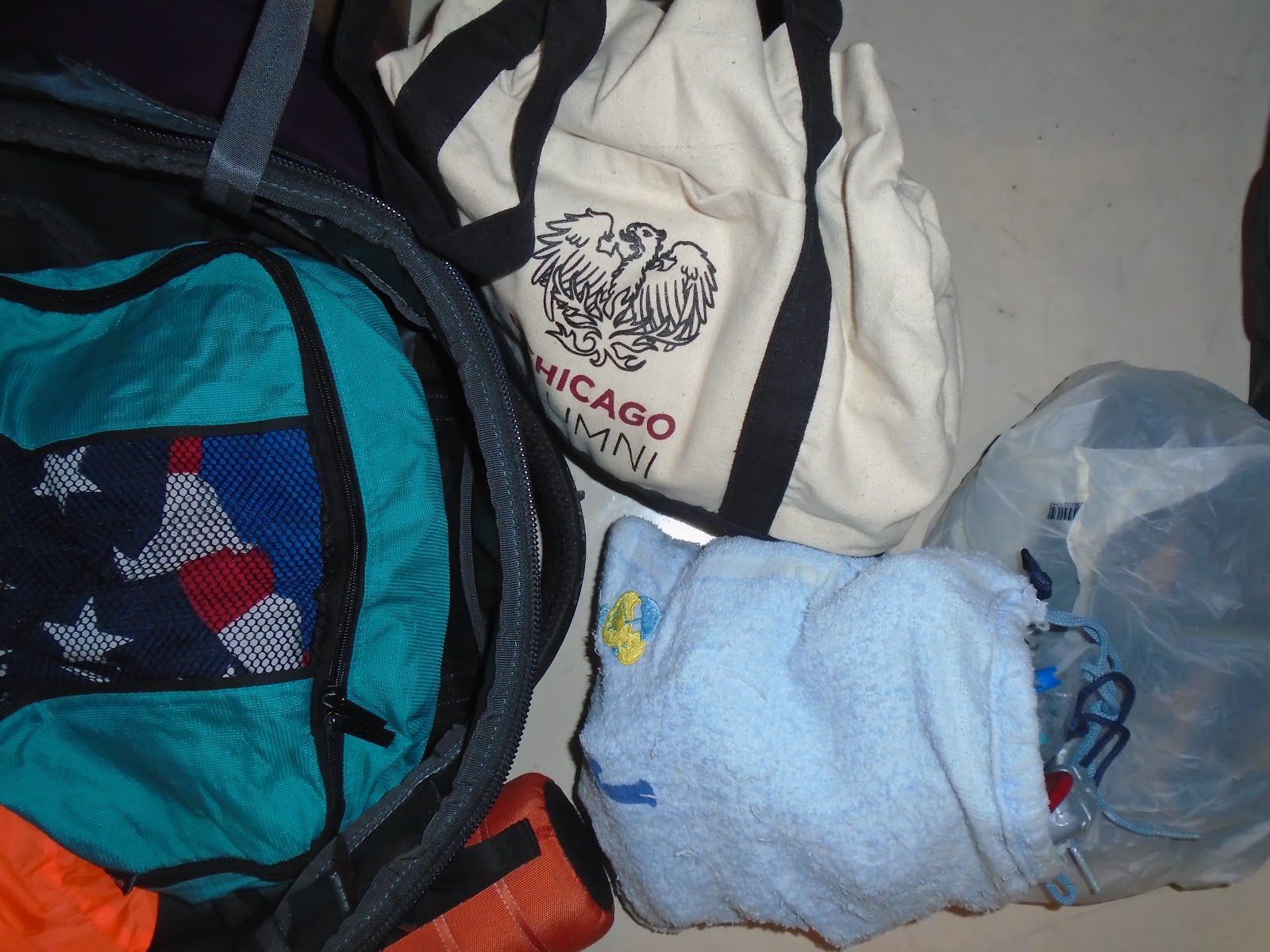
Here we have the main ingredients of the bag, i.e., clothing. The packing cube on the left contains pants/shorts--the only items I fold. The tote bag contains shirts (rolled up), bandanna, and swimsuit. The bath bag (with duck) contains all toiletries. Given that I don't wear makeup or take any prescription drugs, I still don't know why it's so full! Sunscreen and insect repellent? First aid?

The small orange stuff sack contains socks and what a British person once called "smalls." Oh, and the plastic bag contains my sandals. I tuck these in last thing at the top of the backpack, just before I lock it shut.

 The striped bag is for dirty laundry, to keep it separate from everything else in the backpack. The blue packing cube contains some small items that could otherwise be lost too easily: headlamp, portable charger, clothespins, shoelaces, necklace, batteries. This cube tucks in vertically between other items when I pack the backpack horizontally--it takes up so little room you can't even see it in the top picture.
  Tucked into the very bottom of the backpack is this memento of Barack Obama's first inauguration. This was the trip where I almost missed my flight to the U.S. (from Canada) because I was detained for carrying only a sweater in a plastic bag. I was only traveling for the day, but I guess it looked suspicious. So I bought this tote bag for my return from Washington, D.C.

It contains three things I don't need to get out every day. One is a pair of canvas sneakers that I occasionally use, e.g., to go to a gym. (They are also supposed to be acceptable footwear should we ever want to visit an upscale bar, etc., but T. only has her flip flops and hiking boots anyway!) The second is a bunch of small notebooks, which I'm gradually filling with notes from our travels and then mailing "home."


Last, and least frequently removed from the backpack, is a compression bag. When empty it looked like this:
 You put whatever items of clothing you don't need very often in here, squeeze all the air out through the valves at the bottom of the bag, and roll it up. In my case these are a few items of warm clothing that I won't need for months, but are too nice to get rid of. I expect to unpack them in Canada.


So much for the main backpack. Let's check out the bag I carry everywhere!
Decorated with souvenirs from every country (so I don't have to pack any)


 In this top zip compartment is a clip for a keyring, plus a couple of labeled Ziploc bags containing chargers and cords for everything. The duck also lives in here.

Normally this mesh pocket contains a water bottle. At Cape Town airport, the security guy questioned me because he couldn't see a South African flag on my bag! So I try to keep something clear in here. There's also a cross which a friend of T's gave us for our travels. It's not that we believe it has any magic powers, but people all over the world wear or carry symbols of their religion. I like this one.


The other mesh pocket contains my sunglasses and glasses case. There are cloths in here to clean glasses and, because I'm always wearing mine, a harmonica. You never know when I might feel like making music on the road.
The sunglasses are protected by my Australian Open "stubby holder," a foam thing handy for holding cold drinks.


The main compartment of the daypack contains whatever I need during the day. When we are in transit and I have to carry everything, this includes the portable hard drive used for backup, my passport and other essential travel documents (not pictured), and noise-canceling headphones. On a day out I would normally leave these locked up securely where we are staying. The bag also contains a phrase book (or in the case of Asia, Point It, which just has pictures you can point at); my journal for making notes; if necessary, a fleece in a water-resistant stuff sack (the soft inside turns out to form a travel pillow); and a blue travel cube with Ziplocs/plastic bags, which are always handy for keeping liquids separate and occasionally for airline security. Mobile phone and camera (not pictured). Oh, and books. I should really limit myself to one book because the bag would then be less full and heavy, but I have not been successful.

One more item that lives in my daypack in rainy places: a lightweight waterproof jacket (not pictured) that rolls up into its own pocket. When I'm in transit, it clips via a carabiner onto the outside of my backpack.


This last item looks like a Bible carrying case (if you grew up in evangelical country, you know what I'm talking about). It is actually a foil-lined bag that is supposed to keep food cool. It is useful to carry lunch/snacks separately, if we are traveling on a long-distance bus or train. On planes, I use this as a small handbag for anything I'm likely to use during the flight. Book, iPod, Ziploc with toiletries, etc. I always carry my eye mask and ear plugs with me on board--let's face it, I'm unlikely to sleep as it is. My travel mug can also live in here when it's not clipped to a carabiner on the outside of my bag!

So there you have it. How I travel light. And by light, I really mean (since my backpack is well designed, with comfortable waist straps) that the backpack is light enough to walk around carrying, with my hands free. It can squeeze under a bus seat or even onto my lap (think African minibus), and, provided the contents meet security requirements, into the carry-on compartment of a plane. In fact, the daypack even zips onto the backpack so I can carry it all at once, but I find that feature awkward. When I have to carry everything, it's easier for me to wear the daypack in front. Believe me, once you see enough people traveling around it won't feel weird anymore.

You'll notice I still have room for many items that are personal and make me feel at home wherever I go. Your approach should be personal as well; there is no "one size fits all."

I hope I can answer any questions so that you, too, can travel light--whether it's on vacation with only a carry-on, or around the world just doing laundry once a week.

Thursday, October 19, 2017

Continent 2

The premise of these travels is “two women, six continents.” By convention, Europe is considered a continent, although anyone looking at a map can clearly see it shares a land mass with Asia. Before we move on to Asia, though, I feel that I am not yet done with our second continent—Africa.


We visited only a few African countries, and each was very different. So I know we’ve only scratched the surface of this amazing part of the world. I want to return to Tanzania and visit the chimpanzees at Gombe; I want to get the train to Zambia and see the mighty Victoria Falls, on the border with Zimbabwe.

But I also want to see more of all Africa’s regions: Botswana and Namibia, Egypt and Ethiopia, Mali and Mozambique. Some countries are having a hard time right now, but others, of which I’d barely heard, are said to be remarkable places to visit. It’s clear that the Western stereotype of all Africa as a single basket case is a serious distortion.

Just researching the places we visited (and many we didn’t) was fascinating in itself. To think that the Great Pyramid of Giza, one of North Africa’s and the world’s wonders, was the tallest building on earth for nearly four thousand years! It was passed only by—I’d never have guessed this—Lincoln Cathedral, when its spire was completed in 1311.

Here’s another quiz answer that you can have for free. Every modern country in Africa was once the colony of a European power, except one. Ethiopia has always been independent. I knew it was occupied by Fascist Italy, but it still had its long-reigning emperor, Haile Selassie. Maybe that’s why he—Ras Tafari—is so revered by the religion that bears his name?

So I want to go back to these places, because like many people, I grew up knowing Ethiopia only as the place with the Live Aid famine. And I knew of missionaries in various places, but not the awesome churches of the homegrown Christian tradition, or the mosques, or the Hindu temples of Mauritius. 

Okay, so maybe I was just reluctant to leave Mauritius. Getting in gear to explore a whole new continent is a lot harder after the beach, where we could buy samosas and rotis from a guy with a glass basket on the back of his bicycle. Though if there’s one thing I expect from southeast Asia, it’s good street food stalls.

Having ditched all that extra trekking gear, we’ve streamlined down to being actual backpackers. Everything that's not in my day pack is now in here.

So fare thee well, Africa, and I sincerely hope I get to come back again.
Meeting Meru kids at Tengeru Cultural Tourism, Tanzania. Highly recommended!

Thursday, October 12, 2017

Between heaven and earth: Mauritius

So there I was, caught between heaven and earth. Though it wasn’t really that dramatic. We were in the Black River Gorges National Park in Mauritius, hiking up the island’s highest mountain, Piton de la Petite Rivière Noire. Only 828 m (2,717 feet). I knew there was the usual “bit of scrambling” at the top, as well as a fixed chain. But it had been several weeks since Kilimanjaro. So unlike on Lion’s Head in South Africa, where the scrambling and chains came upon us unexpectedly, I was physically prepared for the final ascent to the summit.

Not mentally. I made the mistake of looking back down. We were scrambling up with the aid of a fixed rope; without it, it wasn’t possible to get our footing on the path. T., with all the zest she had previously shown on Lion’s Head, scrambled up ahead of me, only to look around the corner and say it was much more difficult from there.

I didn’t know how far—or rather, how close—it was from that point. All I could think about was getting back down.

Maybe it was the rope. I dislike ropes and chains as much as I do scrambling in general; it’s the reason I’m not a mountain climber, or for that matter, a scuba diver. Something about relying on equipment (on Kili, we were repeatedly told not to rely even on our trekking poles). I just think, I don’t know who fixed this rope. Why shouldn’t it snap on me?

But the real psychological question, which I had time to contemplate as T. made her way, hell-bent, to the top, is why I am making a habit of this. Black River Peak is now the third mountain I have hiked, yet failed to summit. On Kilimanjaro, saving my strength for the descent made sense; I wanted to summit, badly, but simply didn’t have enough left in my body. This was just a wobbly moment. And unlike other wobbly moments, when I’ve always been in a group of people and known that I had to force myself through whether I liked it or not, this time I just looked down, thought “No,” and turned around.

A kind friend and reader wrote to compare my turning around on Kilimanjaro to something Ed Viesturs would do. Viesturs is a U.S. mountain climber who has summited all the major peaks in the world; the only thing we have in common is that he thinks of a mountain as a round trip. Because he is always thinking about how he will get down, as well as get up, he has turned around within meters even of the top of Mount Everest, when he wasn’t sure about the descent. And unlike many of the personnel who were on Everest in the spring of 1996, Viesturs is alive.

But there was nothing wrong with the conditions on Black River Peak, and had I only known how close the summit was, I should have been able to force myself up. And back down. I didn’t. I don’t have those pictures, and I don’t have a good story as to why. 

Permission to fail is a powerful thing, when you have it for the first time in 44 years. Not that I haven’t failed before; I have, spectacularly. But earlier in my life a failure was just the most painful thing, and it took forever to get over it. Now I’m like the gambling ad: “When the fun stops, stop.” 

And this has worrying implications off mountains. I am the type of person who has to force myself to go out the door and do anything, even when I’ve done it before and know that I’m going to have a good time. If my new mantra is “Climb No Mountain,” how am I going to get out of bed in the morning?

Anyway, you all don’t read The Discreet Traveler for my solipsistic mutterings about why, having turned around at half the cruising altitude of a jet airplane, I now can’t do anything. You are probably wondering, Why Mauritius? Or even, Where? 

The Cape of Good Hope is one of the symbolic “corners” of the world. Once you round the southern tip of Africa, you leave the Atlantic Ocean, which separates the Americas from Europe, and enter the Indian Ocean. For this reason, even though we are still closest to Africa, I feel we are already pointed towards Asia. We had the good fortune to stay on this paradise island. It was made possible by a friend who is from Mauritius and her extraordinary generosity; but that’s really T’s story to tell. Few North Americans come to Mauritius, and I can now tell you why: It is just about the furthest place on the planet to get to from N. America. The true “opposite side of the world.” But if there’s one thing I did know about Mauritius, it’s that it was the home of a famous, now sadly extinct bird: the dodo.

The dodo had the misfortune of both tasting good and being unable to fly away, so Europeans promptly hunted it to extinction. T., who always sees the best in everyone, would probably want me to acknowledge that they didn’t know they were hunting it to extinction. They probably thought resources were limitless and there was no reason to modify their behavior in any way. Good thing no one thinks like that nowadays.

I still think it’s a shame about the dodo, especially since it probably didn’t look much like this in real life. But the painting by Jan Savery, in Oxford’s Ashmolean Museum, is what inspired Lewis Carroll to make the Dodo a character; and so it has taken on life after death. You cannot step anywhere in Mauritius now without being urged to buy tacky souvenirs of this dumpy profile. (A pink fridge magnet, if you must know.)

We flew in on a plane with tropical patterns on the seats and swimming fish painted on the walls. It was an old enough plane still to have ashtrays (they were glued shut), and there were other ways Air Mauritius and its partner, South African, reminded me of air travel in former times. Not just the metal utensils, classy as those were. No—when we got to Cape Town airport, and discovered our flight to Johannesburg was delayed, we asked the S.A.A. agent about our connecting time for our flight to Mauritius. I was bowled over to discover that the airline, on its own initiative, had already booked us on an earlier flight to Jo’burg—so we’d better hustle on through security! Imagine an airline not only caring if you missed your connection to another airline, but actually sorting out the problem before the customer had to figure it all out for herself. Further, imagine security moving quickly enough that we had time to board!

Our local cab company in Cape Town, through which we booked a ride to the airport, gets points too. Sometime after we passed between the two giant townships of Langa on the north side of the highway and Gugulethu on the south, our driver braked for a foolish parent duck that was leading its ducklings across the road. The car behind us, fortunately, stopped too, so I trust the ducks were happily united on the other side of the road.
"A Duck and a Dodo" --Alice's Adventures in Wonderland
The dodo made its first appearance on our landing card for the Republic of Mauritius. I paused at the question, “Which countries have you visited in the past six months?” Suffice it to say they barely fit in the space provided. But when the plane touched down at Sir Seewoosagur Ramgoolam International, the crew announcement was, “Welcome to our island paradise.”

I can tell I’m on a paradise island, because first thing every morning (and throughout the day) there is birdsong I’ve never heard anywhere else. I’m not much of a birdwatcher, but the brilliant colors of tropical birds could make one philosophical, even if one wasn’t already. “Like a bird on the wire…”

The voluntary and involuntary movement of people around this world have created some amazing cultural mixes, and Mauritius is one of the most interesting. Because the U.K. was the last colonial power, the official language is English, and Mauritians drive on the left. The language you actually see and hear spoken everywhere, though, is French, because the island was previously Isle de France. And the religion of 50% of Mauritians is Hinduism, which makes it look like we’re closer to Asia—temples everywhere, more than churches and mosques. The currency is the Mauritian rupee. Even the original colonizers, the Dutch, who didn’t stay, left the Creole legacy on Mauritius by bringing in plantation owners and Malagasy slaves to work the sugarcane fields.

We learned some of this history thanks to T’s sister and brother-in-law, whom we were glad to have join us for part of our visit. You can’t just lie around on a beach when my sister-in-law is around. She persuaded us all onto the local bus, an experience in itself, for a day trip to Port Louis, the capital. There we negotiated the trashy alleyways of a port city (not unlike India, she said) and stumbled upon a UNESCO World Heritage site at the waterfront. This is Aapravasi Ghat.

Basically, the people from whom Creoles are descended had been working the sugarcane plantations during the years of French colonization. But after the British took over (some Napoleonic defeat thousands of miles away) and abolished slavery in 1835, they needed new people to do the work. So they started using indentured servitude, what might be called “slavery light,” bringing in immigrants from India. Aapravasi Ghat is where these indentured servants landed, and today, their descendants are 70% of the Mauritian population.

This was especially interesting to me because I, myself, am descended from an indentured servant. Henry Knowles made the trip from England to the American colonies in 1630. The Knowleses subsequently went to Nova Scotia, which is why I can truthfully sing, in the Canadian national anthem, “Terre de nos aïeux.”

History is all very well, but you know food and drink are never far from my mind. Here, too, Mauritius is a dream combination. Imagine a tropical island where everywhere you turn there is Indian food, from curries in the restaurants to samosas on the beach. But, it’s also French in that the grocery stores have warm baguettes. As for drink, the gardener offered T’s sister fresh coconut water from a coconut he just picked himself. That, and fruit juices, are so fresh here I’m finding virgin ways to make cocktails, which I don’t normally drink.

We did discover that “spicy” means something different to Mauritians, possibly because it means something different in French. When a Creole or Mauritian Indian dish is described as spicy, it’s flavorful enough, but not remotely hot. The only way I have discovered to make it hot is to put the ubiquitous chili sauce on it. On reflection, even Indian food was not always spicy in the way English speakers mean it. There were lots of flavors in India before the discovery of chili peppers, which are originally from Mexico.

Isn’t it marvelous how people and ingredients have traveled around the world? Doesn’t it make our lives richer? 

On the beach on Sunday afternoon, I saw a family come down with one person carrying a cooler and another, a tambourine. No party is complete without it! “Our” beach here is Trou aux Biches, which refers to does. Evidently there was once a watering hole for deer here. It looks a little different now, with the Indian Ocean to swim in and one of the best sunset-watching beaches in the world.

Of course, even paradise on earth is not without its flaws. We spoke to some Mauritians who don’t think their coral reef is being properly taken care of. Which is extremely shortsighted, because if the reef is blown up and beaches eroded in order to build more hotels…what are people going to come stay in the hotels for? We were also talking about swimming with dolphins, an amazing experience we had here in Tamarin Bay. We heard from another Mauritian that with more boatloads of tourists visiting the dolphins, they don’t play with divers the way they used to (in fact we weren’t permitted to dive), a possible sign of stress. Conveniently, I only learned this after we’d done it ourselves.
I’m a big believer in the positives of travel and convinced there are ways to make it sustainable. But if, for example, strict limits weren’t placed on visiting the great apes of East Africa, they too would go the infamous way of the dodo.

It’s hard to get too upset about anything in Mauritius, though. Here, even more than in most places, we’re so conscious of how blessed we are to be able to travel, to meet people all over the world and see places for ourselves. I know from my own country[ies] that the place that welcomes you can be very different from the version that appears on the news. 

When faced by any big problem, such as the environment, it’s tempting to think “What impact can I, one person, have?” But you know what? 
“Little drops of water,
Little grains of sand,
Make the mighty ocean
And the pleasant land."*


*Julia Abigail Fletcher Carney

Wednesday, October 4, 2017

Hopelessness and hope: Cape Town

It says something that I've spent ten days in South Africa and am marveling at the United States' capacity for violence and racism. Some people might be expecting me to blame the president, or have some glib solution to intractable problems. I do neither. What I have to say to my native country I say with great love: There is no way this is the best you can do.

Come on, you are Americans! The people who put a man on the moon, led the Allies to victory in 1941-45, and invented so many things. You are the country of Yankee ingenuity. When faced with a challenge, Americans don't wring their hands helplessly or fall in a heap. You pull together and integrate the armed forces or whatever you do. You have to do better than this.

We started our visit to South Africa’s oldest city in the most touristy way possible: with one of those open-top, big red bus tours. Normally I shun such things as tacky and overpriced, but in this case, it was good value for money. I’d been so focused on Kilimanjaro that I’d put almost no effort into researching any of our subsequent travels, so my orientation to Cape Town was nonexistent.

The bus not only took us around the Atlantic Seaboard Coast and up to the Table Mountain cableway (which, as on most days of our visit, was closed because of high winds), but provided more interesting commentary than most such tours. For instance, I was fascinated to learn that the Afrikaans language was first written in Arabic script (early 19th century) by Cape Muslims. Many white Afrikaners in the past, eager to create a myth of racial “purity,” made an effort to convince the world that Afrikaans was just a dialect of Dutch, devoid of African, Asian, and indigenous influences. I am sure I wasn’t the only foreigner, therefore, to associate Afrikaans with white speakers and in particular its apartheid history. In fact, the majority of speakers of this language, the most widely understood in South Africa, are not white, but “Coloured.”

Martin, our unforgettable taxi driver down from Table Mountain on a day the cable car was open, identified as Coloured. At the risk of oversimplifying, the Cape Coloured identity has its roots in people who were taken from East Africa and the East Indies as slaves, as well as the indigenous Khoisan people. During the apartheid period, everyone was classified from birth as white, “native” (black African), or Coloured. Naturally, this history of forced classification means that many people don’t like and no longer use the term Coloured, but others claim it, as a unique culture whose origins are far older than apartheid.
Cable car, Table Mountain
Martin told us his entire life story, including the loss of his longtime job because someone crashed his government car on a drunken evening. Not the most reassuring thing to hear while careening down the road from Table Mountain. One thing Martin had to say from his years in government he probably has in common with most South Africans: Nelson Mandela was his “father,” his hero. Like many other people, he doesn’t think anyone else is up to Mandela’s standard, except the ailing Bishop Tutu.

But he was just getting started. He informed us that the neighborhood where we were now staying, Woodstock, was “the worst” during the apartheid years, run by notorious crime bosses. Now, as we could see, Woodstock is undergoing a transformation into a trendy area—with all the costs that gentrification imposes. We began almost to feel guilty for staying there, as Martin regaled us with the dangers of his own neighborhood (somewhere near the Cape Flats). Every night by 7:00, he parks his BMW, which belongs to the taxi company not him, and is seated in front of the television; otherwise, “a bullet in the head. But don’t worry, ma’am!” he said cheerfully.

After exiting Martin’s taxi, we took our lives in our hands and explored our new neighborhood, which seems to have more craft breweries than gangsters these days. Just down the street from us was The Old Biscuit Mill, like many former factories (including our apartment building) now transformed. On Saturday mornings it’s jam packed with people enjoying artisan craft shopping, live music, and all kinds of wonderful fresh food. Or, as Martin put it, “it’s crazy!” Takes one to know one, buddy.

The railroad is just beyond, and we were never far from people whose lives are clearly running on the wrong side of the tracks. But even in South Africa, a traveler can’t spend all her time thinking about poverty and its evils. After all, I’d mostly recovered from my Kili trek, and there were other mountains to climb.

We started off thinking we would hike Signal Hill, just behind the first place we were staying, in the gay quarter. Despite my best research (i.e., I asked a man walking his dog), we did not find the path up Signal Hill, but ended up on a Lion’s Head trail. Lion’s Head is between Table Mountain and Signal Hill and peaks at 669 m.

We thought we’d stop at the place where the Signal Hill and Lion’s Head trails join, have lunch, then walk back down. But T., having recently celebrated her BIG birthday, was in Energizer Bunny mode, and said, “You’re sure you don’t want to go up a little bit?” “A little bit” turned out to be most of the way up Lion’s Head, including the infamous rock scrambling; we only turned around because the last bit towards the top is ladders and chains. You would have needed to put me in chains to make me continue, after my Kili experience. We hadn’t set out to spend the whole day hiking, and I felt the descent more than usual; but it was nice to get back on the horse, so to speak.

The big red bus people do a harbor cruise, too. And as the sunshine was continuing (the Western Cape is actually suffering a drought), we decided to enjoy this feature of Cape Town the next day. It was worth it just for the seals! They were all over the harbor, obviously so used to boats and people that they couldn’t care less. Not having seen any dassies (rock hyrax) on Table Mountain, I was glad the seals were so generous with their time.


My account of our South African travels would not be complete if I didn’t rave about how well we’ve been eating and drinking. I realize the economy is not doing well here, so things would not be so affordable were we earning rand. Still, South Africans love their meat, and their wine, something I hadn’t tasted since Europe. 
Ostrich shwarma. Not on the menu at every kebab shop!
I can't say enough good things about the national airline, which not only served hot meals on each leg of our flight, but metal utensils! What do they take us for, adults?

Tasting, Old Biscuit Mill wine shop. Martin the taxi driver shops here faithfully!
I really do have to plug for the City Sightseeing bus tours in Cape Town. They took us all around the peninsula, and they also partner with a local initiative in what I found the most interesting part of our stay. That was our visit to the township of Imizamo Yethu, which started to creep up the slopes near Hout Bay only in the 1980s. It was the closest we got to a glimpse of how the majority of black South Africans live to this day.

Primary school
We were lucky enough to be hosted by Mr. Kenny Tokwe, who seems to know everyone in his township, like a kind of informal mayor. Kenny, it turns out, has met with Bob Geldof and the president of Ireland (the Irish have been very involved with building permanent homes in Imizamo Yethu), as well as visited Niagara Falls. A United Church of Canada in St. Catharines, Ontario is another organization that has partnered to help build schools and training programs in the township.

From the road, all you see is tin shacks up the hillside, but there is a lot more to this community. The brick houses (some with shamrocks and Irish green painted on them). The satellite dishes. The churches, which were just letting out their well-dressed congregations at 1:20 on Sunday afternoon, and the more numerous informal bars, which as in Ireland are called shebeens. Kenny told us there are fifteen African nationalities in the township, all speaking English as a common language—plus the Chinese! God bless them, everyone else in Imizamo Yethu is black but everywhere you go in this world, there are Chinese people running shops.
Shebeen. No smoking or pregnant women allowed inside, and free condoms. "Less pregnancy, less AIDS, more fun," as Kenny said.
It’s a hard life and I’m sure not everybody cared for us spending a little bit of our time and money in their community. But some did. The little kids who screamed the Xhosa equivalent of mzungu, and ran to hug us around the legs. (“They’re saying ‘white people,’” Kenny explained unnecessarily. If there’s one thing I know after a month in Africa, it’s how white I am.) And the Arsenal football (soccer) fan who shouted “We love you!” and was only too eager to talk to a Manchester United fan (T.), if only to rib poor Kenny, who supports Liverpool. Football in South Africa has a primarily black and Coloured following. Much was made of the Liverpool theme song “You’ll Never Walk Alone.” 
"If you want to walk fast, walk alone. If you want to walk far, walk with others." --Kenny Tokwe

This country has such formidable obstacles to overcome, but South Africans have already shown their ability to do this. I really hope I get to come back and see how far they get, because there is great potential for the future. You should visit here.
The Bo-Kaap neighborhood. Residents were not allowed to wear bright colors, so they made up for it with their houses.
“I see white folks and colored walking side by side
They’re walking in a column that’s a century wide
It’s still a long and a hard and a bloody ride”

—Shel Silverstein/Jim Friedman, 1963