Thursday, March 9, 2017

Teach them that evil dwells

Sometimes you visit places that are really important. Not enjoyable, but important. That was what I found about the (strangely beautiful) D-day beaches in Normandy in 2000. But I will never visit anywhere as important as where we were today.

Oświęcim and nearby Brzezinka are towns in Poland, better known to the world by their German names. The Nazis originally built a camp at Oświęcim to kill Polish political prisoners, which they did, along with tens of thousands of Roma (people once called Gypsies). When the Auschwitz camp was expanded to Brzezinka (Birkenau), however, the world got its most infamous atrocity: the murder of Jews on a ghoulishly industrial scale. Auschwitz II was not the only death camp the Nazis built in Europe, but what is hard to grasp about it, even today, is the cold-blooded calculation and sheer numbers. It was built like a factory, for the efficient killing of human beings. More than a million Jews were murdered here.

I know we've all heard about Auschwitz, but let that sink in for a minute: More than a million Jews murdered. Here.


Here is important because it is a physical place, on this earth, and you can go there. For free, although  we paid for a guided tour in English, and it was the best tour I've ever had anywhere. It started with someone giving the direction "This bus is going to Auschwitz." There was something chilling even about hearing the words. As soon as we were on the bus (about an hour's journey southwest of Kraków), it started to rain. 
Somehow it seemed appropriate that it was raining, gray, and chilly the rest of the day. All those black and white pictures give the impression that it was forever winter at Auschwitz. You get there by a road that goes through miles of woods. The Poles who lived in Brzezinka before the war were forced out, in many cases to concentration camps in Germany, and the bricks from their buildings were used to construct Auschwitz II--Birkenau, the death camp. 

Birkenau, where the trains arrived straight for death. You have to pace it out on foot to grasp the scale of this place.

“One person’s death is a tragedy, while the death of millions is a statistic.” This quote has been attributed to Josef Stalin, and while it cannot be verified, Stalin would know. Not only because of his own murderous regime, but because the USSR lost more millions during the Second World War than any other country. Thousands of these were Soviet prisoners of war killed here. In one of the great, grim twists of history, it was the Soviet army that finally liberated the camps in 1945.
Cattle car. The train journey from Greece (Poland has hot summers too) took 11 days, so most Greek Jews did not even make it to the camps to die.
Auschwitz I was only partially destroyed by the Nazis as they fled, leaving us this evidence of their crimes. I am trying to give the impression that I got, because "millions" does not tell a story. If you are lucky enough to have a guide like Agniewska, she will tell you that she is not a guide, but a storyteller. The only people who truly know what went on in the death camps, she said, are the survivors. And there are fewer and fewer of them left.

But what has made the strongest impression on me has been meeting survivors, and what most moved me today were photographs of inmates, and records of their names. For each one was a person. If you had glasses, if you were a professor, etc., among the Poles, you were the first to go to the camps, because the Nazis regarded Poles as a slave race, and didn't need any intelligentsia.
Rows of barracks at Auschwitz I

Today, there is a giant pile of glasses on display at Auschwitz. Each pair belonged to someone. There are prayer shawls, and room upon roomful of shoes. I saw the match of one pair flung on the other side of the room, in a different pile. "This is the only place on earth we find shoes without people." 

One woman whose picture hangs on the wall was named Amelia Biezker. I hope I have written her name down right. What struck me about her picture was that she has a lopsided smile--despite the cropped hair and the prison uniform. She was a unique person, who lived from 1912 to 1942. Perhaps hers was one of the everyday stories of people trying to make life better for others, even as they faced their own deaths.
The Germans recorded details of their prisoners--giving every Jewish man the name "Israel" and every woman Sarah.

After a while the Nazis stopped photographing prisoners. They learned that after a few weeks of emaciation, the people were unidentifiable anyway. That is when the tattooing with numbers began. And it only happened here. For the rest of their lives, anywhere in the world, if you saw someone with that tattooed number, it meant that they were at Auschwitz.
Used gas canisters. Zyklon B was a pesticide until the Nazis realized it could kill more than lice.

There is a room in one of the barracks where no pictures are permitted to be taken. When the women were gassed with Zyklon B, all their hair was removed. You have heard these stories of it being braided into rope. These were cheap supplies and, as any businessman knows, that's the way to make money. Companies profited from this place; it was a production line. At the time of the liberation of Auschwitz there was still a pileup of women's hair from the most recent trip to the gas chambers. The Soviets preserved this roomful, wall to wall on both sides. It represents the remains of 40,000 women.


It has to be emphasized: no one ever survived the gas chambers. We know what happened there from the few who survived of one group--the Sonderkommandos, inmates (usually Jewish) who were forced to remove the bodies of the dead. It is because a few of them gave evidence that we have eyewitness accounts. 

Gas chamber 1 at Auschwitz. The Germans did not dynamite it only because they used it as an air raid shelter. You can go in.


After Agniewska told us her father-in-law survived Auschwitz, and after we thanked her for the tour, only then did I think of the word for what she is doing. It's a mitzvah. A good deed ("commandment" in Hebrew). Yes, she is paid to tell the story but it's personal for her; it can't be easy to see and talk about these things every day, that affected someone close to her. It is a mitzvah to tell these stories and to keep the memories of survivors alive.

Today, we live in a world where free people are told to deny evidence, even things their own eyes have seen. Where facts are dismissed and the very pursuit of truth questioned. I am not just talking about the obvious: Holocaust deniers, who are in the curious position of denying Nazi atrocities ever happened while simultaneously applauding Nazi ideology. I am talking about the subtle. 

A Holocaust remembrance that somehow never mentions the Jews. A massacre in Orlando that some were quick to link to Islamism, while omitting that it was the largest single mass killing of homosexuals since the Holocaust. The Nazis murdered queer people too. I've been to the Homomonument in Amsterdam, which stands right next to the Anne Frank House. These are real places you can go and see.
Ruins of gas chamber 2 of 5 at Birkenau. Each killed 2,000 people at one time. Electric elevators then raised bodies to the crematoria.
Few people would dispute the particular evil of the Nazis, unsurpassed by any other evil in the history of the world. But with time and distance, it is too easy to feel far removed from the butchery that happened here, in Europe, in the lifetime of people who are still alive today. Cree songwriter Buffy Sainte-Marie sang:

“Teach them that evil dwells across the sea
Lives in a mountain
Like they see on TV"

What Auschwitz teaches us is that evil is not just bin Laden in a cave or something on television. Evil is a human thing, ever present, part of our world. Evil can be routine, mechanical, someone's everyday work. It doesn’t dwell across the sea but in the heart of every human being—which makes it everyone’s responsibility to fight. It lives in the vandal attacks on American Jewish cemeteries--twice in one week in February. It lives in the dozens of bomb threats against Jewish schools and community centers across the US (eleven states on one day). 

Block 25, where women destined for the gas chambers waited for death.
Yes, this is a travel blog, but how can I go to Auschwitz and not talk about the anti-Semitism happening every day? No one--leader or private citizen--should hesitate, or not know how to answer, when asked "What do you say about hate crimes against Jews?"

“School bell go ‘Ding! Dong! Ding!’
The children all line up
They do what they are told
Take a little drink from the liar's cup"
--“Suffer The Little Children” 


Friday, February 10, 2017

Fareweel and fortune

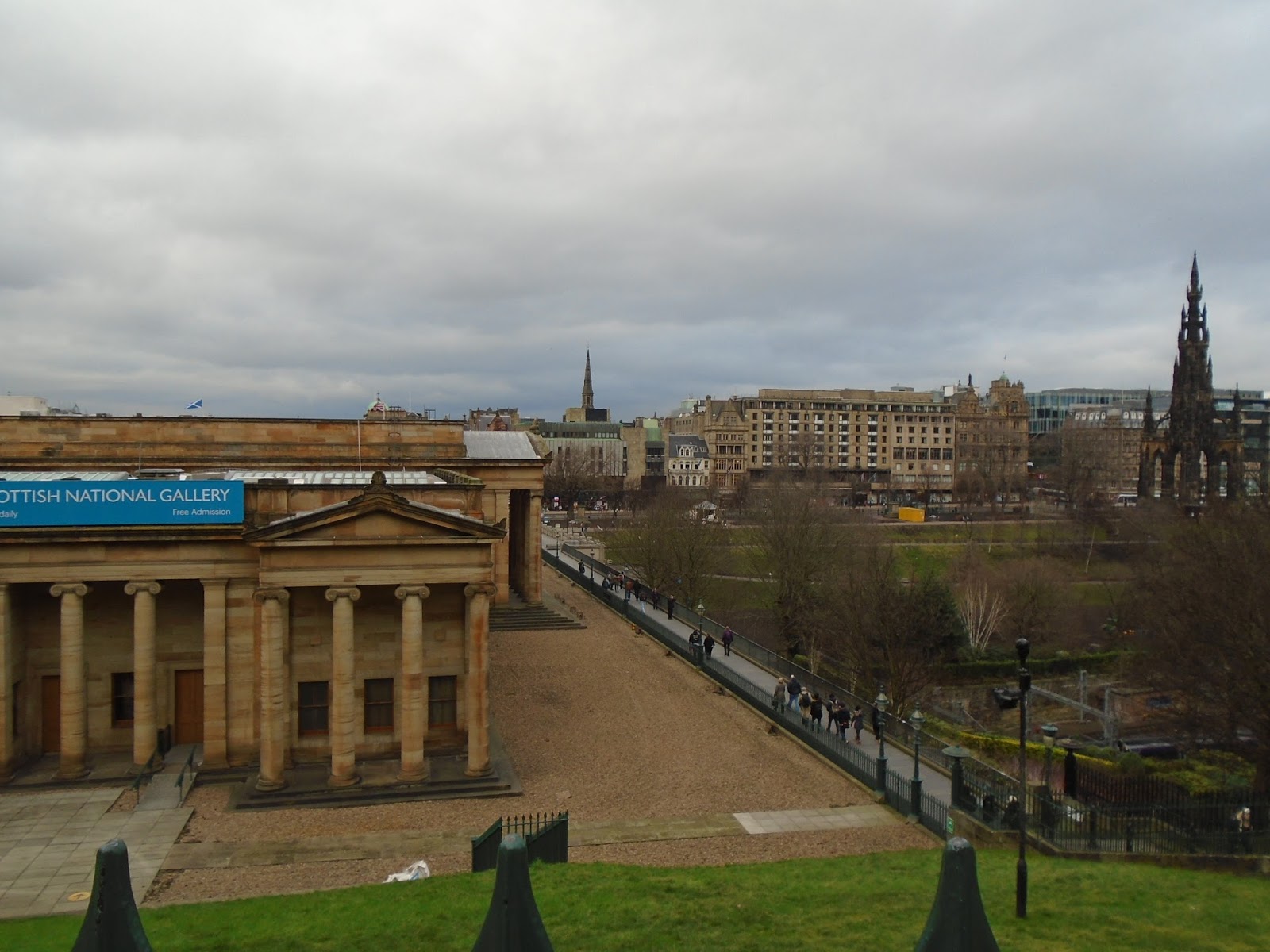
I’ve been to Scotland many times, for pleasure or business. But I haven’t written much about it, and this visit to Edinburgh (for the day job) is the last time I can foresee. So here’s my farewell to Scotland, some impressions of it and the theme I can’t get away from, no matter where in the world I go.
National Gallery of Scotland and Walter Scott Monument

The first time I went to Scotland, like almost every subsequent time, the sun was out as I traveled by rail across the English border. It’s like a little joke between me and the country. To be sure, the weather can be more, well, Scottish. The last time I was up here was with some American family last June, and the summer was relentlessly rainy (see also: Wales). But 23 years ago I was traveling by train for the first time around the United Kingdom (it’s more expensive than the coach, or bus), and I was as enamored of the “standard class” experience as I would become of first class. 

Just picture me, fresh out of university, swigging from a bell-shaped bottle of Bell’s whisky bought from the buffet car, while the backpacker in the next seat thumbed through his Rough Guide. It was the true beginning of The Discreet Traveler. We were going to Glasgow to stay with an elderly lady who had moved to Scotland from England decades earlier and, as the saying has it, gone native. She felt Scottish and, to my ears, she even sounded Scottish. She was an elder in the Church (kirk) of Scotland, cooked delicious salmon, and had an umbrella in a tartan pattern. She belonged in her new country.

I didn’t appreciate until years later why this “Scottishness” of hers was dismissed by anyone south of the border. After all, where I come from, a person can move to a new city, state, or country and adopt it. There are Hoosiers who weren’t born in Indiana and Canadians who weren’t born in Canada, so why not a Scot who was born somewhere else?

But nope. That is not the Old World way of doing things. In the Old World, where a person was born can be the most important thing about her, even though it’s something over which she clearly has no control. And increasingly, this is becoming true in the New World as well.

You see, as much as I try to go local myself (eating a delicious smoked haddock soup called Cullen skink for supper, haggis and black pudding with my breakfast), I am where I was born, wherever I go in the world. I didn’t choose to be born in the USA, and while it’s certainly part of me, I don’t take any credit for it. It comes with many privileges I didn’t earn, and I don’t even think about all of them.

Do you have a passport? Most Americans don’t, but when they apply for one, they’re unusually fortunate. A US passport, like Canadian, British, and European Union passports, get you into most countries in the world with minimal hassle. Often you don’t have to apply for a visa at all, and if you do, it’s usually not a big deal or very expensive. 

People with passports from some other countries, however, find it very difficult to travel anywhere. Then there are the many people who aren’t able to get passports, because their own country denies them one (Syria), or because they are refugees, or because they are stateless. And then there are the people who are citizens of privileged countries, but because they were born somewhere else, they are still held responsible for that one unchangeable fact about themselves. The crime of where they were born.

Like Maher Arar, a dual Canadian-Syrian citizen who was "extraordinarily rendered" by the United States in 2002. That is to say, deported back to Syria, which tortured him. Mr. Arar had lived in Canada for fifteen years, but his Canadian passport did him no good, because the USA decided to treat him on the basis of where he was born. Being born in Syria of course is not a crime, but it’s nothing new to treat it as one.

Or a British doctor I was speaking to in Edinburgh, who explained that he can’t enter India at all, because he was born in Pakistan. “I’m Christian,” he told me; “I don’t even have a Muslim name. But India’s decided we’re all terrorists.” The world’s largest democracy has deemed anyone born in its neighbor to be inadmissible to the country.

It was already difficult to travel to the United States, he said. Ever since September 11, just having dark skin, it was such a hassle. (I have heard this many times before, but of course, I don’t like thinking it’s true.) Now, this British-accented physician expects never to travel to the US again. Pakistan isn’t yet on the list of banned countries, despite an actual history of terrorist attacks both internal and external. But being Pakistani-born is enough trouble even for someone with a British passport, who lives here.

Nationalism is on the rise all over the world. English nationalism has led to “Brexit” from the EU and Scottish nationalism is reacting against that. Jill Stephenson, Professor Emeritus of History at the University of Edinburgh, wrote in The Scotsman of how “cybernats” tell her she “hates Scotland” because she voted No in the Scottish independence referendum. Their view is that there is only one way to be Scottish, and she is not it. I have also been told that I “hate the United States of America” when I’ve expressed a way of being American that was different from the speaker’s. 
Glaswegian beer

What if we belong to more than one nation? What if we want to be part of a United Kingdom, as Jill Stephenson does; or a united Europe; or the world? The UK prime minister has said, “If you believe you are a citizen of the world, you are a citizen of nowhere.” My acquired nationality has been dismissed in words like these: “You were born in America. End of.”

On my way to my return train, I stopped in a little shop in Edinburgh run by a young Sikh man. He saw the red ribbon on my jacket and recognized it as the AIDS ribbon. This emboldened him to talk to me for a few minutes about the people of Edinburgh and how he found the larger cities of Glasgow and London to be more open. I asked if he meant different kinds of people, and he said yes.

Different how? Different religions, national origins, sexualities? I didn’t ask him where he was born or if he is a British citizen. Does he feel Scottish? Does Sikhism make a difference, or his skin color?

So let me nail my colors to the mast: I’m not Scottish, but I want Scotland to stay in the United Kingdom. The UK is leaving the EU, but I voted for it to stay. I have passports from two privileged nations, and I know I am privileged to be a citizen of even one.

People may “feel” Scottish or British or European or a citizen of the world. But what I mostly feel is fortunate.


Monday, January 30, 2017

An ordinary relationship

You think this is going to be an anti-Trump screed, but he wasn't necessarily wrong about this. Before he even won last year's Republican primary, he put his finger on something that the world has lost. And we didn't even realize until now that it was gone.
http://www.independent.co.uk/news/uk/politics/donald-trump-theresa-may-holding-hands-chivalrous-gesture-downing-street-a7551021.html

Sure, it gives me the creeps that he held hands with the prime minister of Britain, as it would to see him touch any woman. Ronnie and Maggie this was not. But Theresa May is part of the problem, too--waiting for French and German leadership before her government would criticize the president's latest executive order. 

What we are seeing is not just a new administration in the USA or a new, pro-Brexit British government. This is the end of leadership in the world.

Since World War II, when the Allies were victorious, it has become customary to refer to the President of the United States as "the leader of the free world." But like so much about the presidency, it turns out that this was only custom. It's not written in law anywhere that the president should lead the free world, and when he was a candidate, Donald promised not to do so. Think about how many conventions--of respect for other American institutions--he violated, and gained support by violating. He ridiculed former president George W. Bush, a fellow Republican, who all Republicans previously had said kept the country safe. He spoke what many Americans think but no candidate had dared to say: that the wars in Iraq and Afghanistan were a waste. And he implied that the sacrifice of soldiers (like Humayun Khan) was in vain.

If you need more evidence that America has turned upside down, look at the other side. It was the Democratic convention, not the Republican, that played on patriotism, military veterans, and how great America already was. Never before had a Republican painted such a dark, pessimistic picture of America as a loser--or been rewarded for it. And until Donald attacked the Central Intelligence Agency, had you ever heard a good word on the left for the CIA?

He promised a new world in which America would be great--on its own, with no leadership role. Not in NATO, nor in world trade. He promised tighter borders and protectionist laws. No longer will China, the emerging global superpower, take advantage of the US.

Republicans don't normally campaign by putting down America, talking about how awful it is to be black in "the inner cities" or how other countries are always taking advantage of our "stupid" country. The irony is, by winning with such a vision, the president all but guarantees that it will come true.
  
By vacating that global leadership role, he is ceding it. To China (and Russia, which is still a nuclear superpower). Those countries have lots more experience being dictatorships than the US does. They will eat America alive.

The USA has always thought of itself as an exceptional country, but it's been a long time since it was anywhere near the top on a host of measures: human rights, education, violent crime, work-life balance. There's nothing written in the Constitution that says the US has to be a leader, let alone an example to the rest of the world. 

In trying to make America a great country "again," this administration is actually making it more of an ordinary one. Now, there's nothing wrong with being just one of many countries. Every other country manages it. British people love Britain, the French love France, yet it has been ages since the French and British empires battled for world supremacy. Canadians think they live in the greatest nation on earth, but that doesn't mean they think all other nations want to be like Canada.

But think about what the USA has to lose. World-class researchers will no longer come to a country that muzzles scientists. The best and the brightest won't come where immigrants are unwelcome. The finest health care in the world will be affordable to fewer of America's own people than ever.

And you know what? The CIA was wrong about weapons of mass destruction in Iraq. The war was a terrible mistake. A lot of people around the world will be glad if the US really does mind its own business.

I just hate to see what steps up in its place.


Saturday, January 21, 2017

The discreet hiker 2: The coming of winter

Those of you who have been following The Discreet Traveler for a while know that I was at Barack Obama's inauguration eight years ago. But I had to cut my nails on Friday, so this post is about something totally different.

A gentleman asked me to take his picture with that memorial in the background, and then offered to take mine. He told me to have a blessed year—not day, but year! Only later did I absorb the significance of two strangers, a white girl from the South and a black man, taking each other’s pictures at the Lincoln Memorial. 

Winter is coming. I don't just say this because of the resistance to the horror upon us (resisters are being called "snowflakes"). It's that I've been gearing up for hiking, specifically cold-weather hiking, and I actually miss the cold (think below -10 degrees Celsius). I can hardly wait to try some of this stuff out.

Why? Because I'm trekking Mount Kilimanjaro, the highest peak on the continent of Africa, and the tallest freestanding mountain in the world.

The Discreet Traveler is actually going quite a few places this year, and I hope you, my millions of readers, will be interested enough to follow along. But as Marek Bron says in his excellent travel resource, many travelers spend far too much too much advance time planning their itinerary, and not enough deciding what to pack (and not pack). So, that's where I'm starting. And while many of the things I'll need on Kilimanjaro I would pack anyway, there are some specific requirements, as any spin around the internet can tell you.


Photograph: Bob Haisman


The real concern on Kili is the extremes of weather. Because one hikes from an equatorial zone (rainforest climate) up to an altitude with arctic conditions, one has to be prepared for all weathers in between. Apparently, some people flying into Tanzania have a hard time believing the top of the mountain can be that cold, even though they can look up and see "the snows of Kilimanjaro" and the glaciers for themselves.

This skepticism is not new. William Desborough Cooley, who in the 1840s was regarded as an East Africa expert despite never traveling there himself, spent the rest of his life disputing eyewitness accounts of Kilimanjaro and insisting that there could not be snow and ice that near to the equator. The arrogance of ignoring evidence is with us still!

As I mentioned in The discreet hiker (1), I've become a big convert of wearing layers to manage different temperatures. I've come to think that's the way to dress no matter where I am, even in cities doing more (or less) pedestrian activities. But realistically, I think about all the years I lived in Toronto, and Chicago before that, walking everywhere (never owning a car), waiting for transit, etc. I always had a big winter coat--the kind that's too bulky and impractical to wear on Kilimanjaro, or carry around the world, for that matter. I never remember wearing more than one layer on my hands in my entire life--just swapped gloves for mittens if I wanted to play in the snow. I've never worn more than two layers on my legs, and the base layer in that case was cotton long johns, when we all know now that cotton is bad because it doesn't wick moisture from the skin. 

None of this seems to have hurt me. I got frostnip on a toe once when I was out dogsledding for 5 hours--not moving around much (the dogs did all that) and wearing only one pair of socks, although they were thick socks.  My toe stopped being numb eventually. I've never worn sock liners or used hand or toe warmers. The coldest I've ever been was one period in Chicago--not even Canada--when the temperature dropped to 40 below 0.

Point of trivia: -40 is where the Fahrenheit and the Celsius scales meet. No matter where you are, -40 is damn cold. That's not counting wind chill, which in a continental winter is measured religiously: how cold you are likely to feel. That time in Chicago, the wind chill was said to be -70 degrees F. We did not wait at the bus stop. We stayed inside and rushed outside when the bus came. I remember looking out my apartment window and seeing Lake Shore Drive deserted, empty of cars for once. The mail was not delivered that day.

I do not expect it to be -40 on Kilimanjaro. Still, it's windy at the top! My goal is to always have one more layer in my backpack than I'm actually wearing. I may not ever need that extra layer, but it will give me great comfort to know that it's there.

(This is probably not important if you're just traveling/living in a city. Worst case scenario, you can buy a cheap umbrella or just duck into a store or coffeeshop if it's raining really hard. But living in the outdoors, on a hiking and camping trip, it's imperative to stay warm and dry. The body is much better at keeping warm, with proper insulation, than at getting warm after it's already chilled from wind or precipitation.)

So what am I going to wear? And how am I going to get it all without breaking my travel budget? I'd prefer to spend extra dollars on acclimatization days (i.e., a more gradual route to high altitude) and to make sure the Tanzanian crew is properly compensated for all their hard work--not brand new items that I may never use again.

Starting from the inside out:

1. Base layer (next to the skin): Underwear should be self-explanatory, although for really cold conditions, there's no substitute for wicking long underwear. I chose a merino wool/synthetic blend that keeps one warm without stinking after a day's wear. Not cheap, but there's no going without it. Check the outdoor stores for sales if you have enough time in advance.

2. The next layer I just like to call "regular clothes." As anywhere else, you wear a shirt and pants, with the long undershirt and tights underneath at the coldest temperatures (-30 C, or summit night!) You can buy trekking pants, but I already have two light pairs from when I was a volunteer at the London 2012 Games. (I'm just proud they still fit me, to be honest). I was going to take them traveling anyway. As for shirts, I have a few T-shirts (both short- and long-sleeved) made of "technical" material that I got from running 5 or 10Ks (yes, I used to do this). At home I normally prefer cotton shirts, so I'm putting these synthetic, wicking shirts into my backpack for travel.

3. Mid- or insulating layers. Fleece is a good insulating material, light and packable. I can no longer remember where I got it, but I have a thin fleece vest that is great for extra insulation, as well as a thicker, "Polartec" fleece with sleeves. The thicker fleece is great as an outer layer in milder (dry) conditions, and the vest is an extra layer of warmth underneath, without the bulk of yet another pair of sleeves.

Please note--so far nothing on this list have I bought, except underwear :-)

4. "A packable down jacket is the secret weapon of ultralight backpacking." (There are ethical as well as synthetic variations.) When I found one on sale for 2/3 off, I took the plunge. I've had occasion to use it a few times hiking and camping in the cold so far, and I have to say it's incredible. Nothing provides that kind of instant coziness when sitting around at night, and even though it weighs almost nothing and packs down into a small ball, I spread it on top of my sleeping bag and it felt like an extra blanket immediately. I don't anticipate hiking in my down jacket except on the coldest night, but layered with fleece, I'm going to bet it's as warm as one of those old winter coats. And much more versatile!

5. Outer layer: This is for wind and water resistance. There is always a tradeoff between waterproof (like a poncho) and breathable. The Olympics provided me with a light rain jacket that rolls into its own pocket. For most occasions, I see that being adequate in the rain, but for wet days on Kili I'll be more comfortable with a slightly heavier, high-tech material such as Gore-Tex or Hy-Vent. Luckily for me, T. has just such a jacket that she won't be needing, as while I'm up on a windy ridge somewhere on summit night, she'll be celebrating a BIG birthday far below in Arusha! 

Whether you borrow or buy such a wind- and waterproof layer, do go for a size larger, or at least check that it can go over all your other layers of clothes at the same time.

The torso is most important to keep warm, but in the coldest weather extra layers on the legs are necessary too. I have an old pair of fleecy pants that I plan to substitute for the light walking pants (the rest of the nights they can serve as pajama bottoms). I also bought a pair of rain pants made of similar material to the outer jacket. These might seem like an unnecessary expense, but it can rain on the lower elevations of Kili at any time, and once clothes are wet on the mountain, they're useless. So I plan to keep these, the waterproof jacket, and one extra warm layer in my daypack at all times. (I live and do most of my hiking in England, so there are plenty of opportunities to use the rain pants in the meantime! Make sure they fit comfortably over whatever you're walking in, and that they're flexible enough to bend your knees.)

I've raved elsewhere about merino wool hiking socks, which I pack all the time for traveling now. The best recommendation I've found for summit night is to get a thick thermal pair, and wear these on top of thin liner socks (a wicking material like polypropylene). I've also tried toe warmers and removable thermal insoles in my boots. I hope, with the boots I've broken in hiking and walk pretty much everywhere in, that these will withstand the coldest, windiest weather!

A few more clothing items--I'll save non-clothing for another post:


  • You're covered from your feet to your shoulders now. But hand protection is important. I have a pair of thin, fleecy running gloves that have some water resistance in normal temperatures; I plan to have these available always, as hands can get chilly when I'm holding hiking poles. I'm also borrowing a pair of thin glove liners that can go under these or, on the coldest night, the only pair of mittens I've had in my adult life (old, but resistant enough to snow and wind). 
  • As it happened, I recently lost my scarf, and instead of replacing it I got a balaclava (ski mask in North American). It's not heavy--a thin merino wool blend--though it does make me look a little like a bank robber when I have it pulled over my face. More comfortable than a scarf, though, and I can pull it under my chin if I just need my neck and head warmed. Covers the ears completely.
  • Two hats are essential. For sun and rain, I finally treated myself to a Tilley hat, which I'd wanted ever since I moved to Canada (it's part of becoming Canadian, like the citizenship test or Tim Hortons). It has proven perfect in both kinds of weather, and even ties under the chin if necessary. For cold nights and sleeping in camp, there's no substitute for a toque! That is to say, a woolly or fleecy hat. If you live anywhere with winter, you probably already own one. It may not be fashionable, but after a couple of nights in a tent you will no longer care about any of that.
Whether you're booking a trek up Kilimanjaro or just planning how to get through the winter in the northern hemisphere, I hope this layering logic makes sense. By using thin layers, some of which you probably already own, and taking them off/putting them on as the temperature changes (say, a wind chill drop of 10 C), you can achieve maximal comfort with minimal extra expense. 

*BONUS FUN THING: See how many Canadian references you can find in the layers of this post (top to bottom)!

Thursday, December 29, 2016

A democrat abroad

A few weeks after the U.S. election, I was with some American voters in a bar in London. There we were, the despised global elite, trying to figure out why our world was in pieces. There was an African-American man who has lived here for seventeen years (married to another man), a young straight couple, and a Mexican-born woman who became a U.S. citizen twenty years ago.

At one point, I wondered aloud the thing I still haven't gotten an answer to: how Donald won white women. A majority of women who look, but clearly do not think, like me voted for a sexual braggart, a misogynist pig--never mind all the piddly details like racism and being completely incompetent. The African-American man speculated that this had to do with their husbands.

"If their husbands have been talking for eight years about how much they hate President Obama," he said, "and how he's the worst thing that ever happened to the country, maybe these women just couldn't stand it. Maybe they voted against Hillary Clinton because they just couldn't stand hearing their husbands bitch about her for the next four years."

I told him this was one of the most disempowering things about women that I have ever heard. I also wondered if he was right. He knows more about husbands than I do.

The Mexican-American woman talked about one of her best friends, a white woman back in the U.S. She couldn't get past how her friend was voting for Don, supposedly because of business reasons. How this woman was so tone-deaf to the anti-Mexican and anti-immigrant things he said and promised to do. "But I'm your friend," the Mexican-American woman said. "You know me."

The young white woman at our table volunteered that she, personally, did not know and had not talked to a single person who had voted or even leaned Don. We agreed that this was part of the problem: that it's possible to live in the United States, and certainly outside, and not know anyone who doesn't think as little of him as we do. That's why so many Democrats were blindsided by his victory. That, and the fact that millions more people did vote for Hillary Clinton, just not in the right cities and states.

But they should not have been blindsided.

Nearly a year ago, Benjamin Studebaker wrote about the Democratic primary in an essay called "Why Bernie vs Hillary Matters More Than People Think." In it, he spelled out the ideology of neoliberalism that has prevailed since the Carter presidency, in contrast to the broadening of economic equality practiced by both Republican and Democratic administrations from the 1930s to the 1970s. He explained that Bernie Sanders, the wild-eyed socialist, actually represented this older tradition, and spoke to the concerns of working people who felt left out by the economic inequality of globalization.

His conclusion was that "if this is the year when the voting public decides that it’s done with neoliberalism, the party that nominates a neoliberal candidate will likely lose. If democrats don’t nominate and support the left egalitarian political movement, if they instead continue to nominate neoliberals who continue to allow incomes to stagnate, they are ensuring that sooner or later (and probably sooner) disaffected poor and working Americans will choose right nationalism as the next dominant economic ideology for potentially decades to come."

And that is exactly what happened. While Hillary Rodham Clinton would have been different in one historic sense--the U.S.A. has never elected and may never elect a female president--we should all be able to agree that Donald is really different. No political experience, no consistent political ideology or party loyalty, and no respect whatever for the norms and bounds of political discourse. Indeed, these were his selling points. The more out of bounds he behaved, the more outrageous things he said and did that had even Republicans recoiling in horror, the more his passionate supporters embraced him.

It would be neither possible nor helpful to know whether the outcome could have been different with a different Democratic candidate. I was told during the primary to go and read history (very condescendingly) and told why a socialist, never mind a secular Jew, could never win in America, and that may very well be true. The African-American voter at my table reminded us that black voters were slow to get on board with Barack Obama at first, and he doubts they'd ever have gone for Bernie Sanders. His own relatives, like many African-Americans, were firmly in Hillary's camp in 2008. They didn't believe an African-American could win the presidency. Many white Americans seem shocked at the intensity of the racist backlash to Obama, but I doubt many black Americans are.

What is helpful is that there is an economic analysis. While many factors conspired in Don's favor to win him the electoral vote, where he won (i.e., where Clinton lost) was by extremely narrow margins in Michigan, Wisconsin, and Pennsylvania. You'll remember the pollsters being shocked by Sanders's win in the Michigan primary, but we who watched him debate Clinton there weren't shocked. In fact T. turned to me that night and said, "He's won [in Michigan]." While Clinton said measured, incremental things about fracking and other issues, Sanders simply ruled it out. This is not to her discredit; it's just to say that Sanders knew what was worrying the voters, in those states in particular, for whom economic inequality is a long-term problem.

Dave Eggers quoted Rob Mickey, a political scientist in Michigan: "She said, ‘I’m not crazy’ and ‘I’m not a sexist racist pig’, but for working class whites that’s not enough." This is what is really hard for many people like me to understand: Shouldn't being a crazy, racist, sexist pig be enough to disqualify someone from the presidency?  Before the election and especially since, many of us who dreaded this outcome, or were even shocked by it, have been wondering what is wrong with these voters and how they could let us down. I know of an African-American woman who looks at this election and all she sees is racial resentment and how the Republican exploited it. I know white women who see only that a qualified woman lost to an unqualified man. And while both pictures are incomplete, neither is wrong.

But if I may cite Bill Clinton for a moment: It's the economy, stupid. I don't want to in any way minimize the alarming sexism, racism, and anti-Semitism. In her brilliant challenge to journalists, Christiane Amanpour said, "Since when did anti-Semitism stop being a litmus test in this country?"  But for voters who are struggling, it is always the economy. This seems like a strong and reductive statement so let me be clear what I mean.

First of all, I don't believe for a moment that the next administration will do anything but make the economic inequality in the U.S.A. even worse than it already is. If it got worse under every administration, Democratic or Republican, since Carter, why on earth would a House of Representatives led by Paul Ryan do any better? Just as with "Brexit," those voters who most wanted change are likely to do the worst out of it. And if in order to vote for that change they overlooked or accepted all kinds of vile speech and plans, all kinds of violations of democratic convention, then that is indeed deplorable.

But without cutting them any slack for that, I also think we who are "high information" voters, or who aren't feeling the pain of economic inequality as keenly as others, can sometimes be unaware of their real situation. Sure, if you're a white guy blaming Mexicans or African-Americans, or a white woman willing to throw her sisters under the bus because you can't take four more years of your husband being enraged about Obamacare, then that's deplorable. But voters aren't always "low information" because they choose to watch the wrong channel. Researching all your options politically is something a person working two or three minimum-wage jobs, and raising kids on top of that, just doesn't have time for.

I hasten to add that the Don voters in the states maligned as "Rust Belt" were not the poorest. Poor people have poor voter turnout, and it's no wonder, in a country where polls close at 7:00 PM and Election Day is a workday. The interests of the very poorest Americans are almost never mentioned, let alone acted on.

But if you are struggling--if you haven't gotten a real wage increase, as collectively most Americans have not, since the 1960s--then you are going to feel worse off. And it won't help to tell you that I am better off because I could now marry my same-sex partner, when I never could before. It won't help to tell you that global poverty is down by an astonishing amount in the past 25 years, since much of that is due to the explosion of middle-class jobs in China. After all, those are the jobs that were stolen from you. Why do a billion Chinese people continue to tolerate their own lack of democracy and individual freedom? They have the jobs!

Of course, for African-Americans who were fighting just for the right to vote 50 years ago, America really is better (although not as much better as one might have hoped). For LGBT Americans, who were criminalized into invisibility 50 years ago, it is astonishingly better (although now facing serious setbacks, especially with Mike Pence in the vice presidency). But if you are a straight white person worse off than the generation before you, or not better off, I can see how those facts just don't have an impact on your perceptions. Just dismissing you as not being willing to "share the pie" with more different kinds of people is too simplistic. It is not just Don voters who feel that the world economy is not working for them. Most Americans feel that the system is not working for everybody, or working as well as it should.

Even since the election, I am still reading smug publications that say globalization is unstoppable, that nations are helpless in the face of it and there is nothing governments can do to help their people. This is very dangerous. If there is nothing government can do to help people, then people have no stake in their government. Voter turnout will be even lower, and democracy even more vulnerable to takeover by conscienceless populists who play on the absolute worst in people.

It may very well be that technology and not just trade agreements inevitably eliminated a lot of jobs; but it is also clear, and widely acknowledged, that governments have done a poor job of planning for those outcomes and helping communities that were disproportionately devastated by them. Is the answer Sanders and Warren-style left egalitarianism, or is it Donald and the Tea Party? Because it clearly isn't Clinton centrism anymore. That worked for Bill in the 1990s, and why wouldn't it? The economy was booming then.

It's the economy, stupid. If people are worried about their jobs, their incomes, being able to take care of their kids, then to put it bluntly nothing else matters. They are not going to care about Russia, at least not in 2016. They are not going to care about racism or sexism or homophobia. They are certainly not going to care about immigrants who, in the absence of "high information," they think about lumped all together, from someone illegally taking work away from them to an Islamist terrorist.

And who thought "Islamophobia" as a label was going to work in this election? Most Americans probably don't know anyone Muslim. To them, "Muslims" are the ones who crashed into the World Trade Center. If there isn't anything wrong with Islam, then why was it such a slur to call President Obama a Muslim (something easily disproved which, nevertheless, 40% of all Republicans chose to continue believing)? For the record, I don't think this is a fair characterization at all; I know from my own experience that Christians behave in all kinds of ways and it's unfair to generalize about us only from the worst examples. But as a society, we are nowhere near accepting this, any more than we are "post-racial" or okay with transgender people.

Look at what happened in North Carolina. Pat McCrory, the Republican governor who inexplicably tied himself to an anti-trans "bathroom law," lost, even though the state went heavily for Don. Who was splitting their tickets? Did North Carolinians care so much about trans issues that they voted against McCrory despite voting Republican for president? Or was it that all the boycotting, the loss of the NBA All-Star game, etc. cost the state money? We didn't get any gay rights because straight people all of a sudden started honoring same-sex love. Businesses turned towards us because we are customers.

People vote with their pocketbooks. That is human nature and doesn't make them bad. When they feel someone is listening about the "rigged economy," when they feel represented, then they might care about their neighbors of a different sexual orientation or religion or race than themselves. Or they might not. But hardcore bigots are never going to vote for a liberal anyway. We need to concentrate on the large number of people who will vote for progressive interests, if we make the case to them.

The left is pilloried for "political correctness" and "identity politics," but the bread and butter of the left has always been reducing inequality and bettering the lives of working people. Its strength is coalitions. Less well-off white people and people of color are natural allies, which is why it's always been a right-wing strategy to divide them--to devastating effect.

What we are witnessing now is the culmination of Nixon's Southern Strategy, where the G.O.P. is an actual white supremacist party, yet still doing jack squat for those left-behind communities. Where I come from, Reagan is revered; yet when Reagan became president the top tax rate was 70%. Do we really think it needs further reduction from today's levels? How is that supposed to help the people who left the Democratic party in 1980, and have never returned?

Democrats used to be the party of working people, and campaigned against Republicans as the party of the rich. Somehow by this election, Hillary got pilloried for her connections to Goldman Sachs, but it is Donald who is appointing an actual Goldman Sachs banker to be his secretary of the treasury. In other words, for all his bombast and alarming behavior, he promises, in government, to behave like a Reagan-Bush Republican. Indeed, it is the support of most elected Republicans that got him--and them--the government.

Republicans have not changed that much. They are still the party of the rich, and will make every effort to enhance those people's prospects, at the expense of everyone else. When the disaffected people who thought Don was going to help them economically realize that, once again, they've been had, there needs to be a party of working people who can help everyone hurt by economic inequality.

We had better be ready.

Sunday, December 18, 2016

Christmas

The Discreet Traveler has been traveling a lot and I thought I would write about that, or what's been brewing in my mind for the past month, ever since the latest disaster of populism rocked my international elitist world. I'm sure I'll have more to say about that in the New Year, but it's the fourth and last Sunday of Advent--the church season of preparing for Christ's birth. And I've been struggling to feel "Christmas-y," let alone handle my Christian faith, in the wake of what has been a terrible year for many people.

So I really didn't think I'd be writing about Christmas. I feel as useless as the rest of the world, wringing my hands about Syria, a genocide happening before our eyes. I feel out of my century: outraged about Russia, of all earthly powers. And if you don't connect those two outrages, as Rachel Spangler wrote, "you're doing it wrong." The clichés about the Christmas story as a Middle Eastern family seeking refuge seem so obvious as to be not worth pointing out again this year. To whom would I be preaching? Would anyone get it this Christmas who didn’t care before?

But it was thinking about all this, in fact, that compelled me to write about Christmas. Because it has been brought home to me over the past few weeks how important my “Christian world view,” as my father puts it, is to me. For all the disgust I feel when I hear religion linked to some atrocity—and Lord, 2016 has seen so many—my faith is not so much a part of my life, as the light in which I see life.

The secularization of the Christmas season, acknowledging other faiths, not saying “Merry Christmas” and so forth is seen by many Americans as an attack on, or at least invalidating, Christianity. In my experience this is more true in places where Christmas and Christian imagery are overtly talked about in public. In England, where I currently live, “Christmas” is everywhere—no “Happy Holidays” to be heard—yet dig too deeply into the Christmas story and you are likely to embarrass people, or they to embarrass you. Sure, all the kids are in the nativity pageant, but really believe? That doesn’t matter. I get the impression that Christ is like a lesser Santa Claus, just another pleasant lie to tell children.

I say this not to criticize one country versus another. I say it because, from the Christian to the person most contemptuous of religion, many people are confused about the link between Christianity and those earthly powers we call nations. Put simply, there is none. There is serving Christ and there’s serving our country, and it’s clear which is supposed to be our priority.

This sounds understandably terrifying to many secularists, who fear theocracy. A Christian Taliban, superseding national values with the cross of Christ, would be as bad as an Islamic state imposing sharia.

But it wouldn’t be Christian. As Madeleine L’Engle wrote, “The Church that went along with Hitler was not the church. The Church was in the concentration camps.”[1] Christianity is unique among world religions in claiming that God came down to earth to live a human life. That is the Christmas story that makes people squirm when you press them about it. If our King is God, born in a stable, then that is the leader we are supposed to follow, whether or not it conflicts with our nation’s call. We hope it doesn’t, but when Jesus calls, Christians are supposed to follow him—even if his way leads to the cross.

Whether you are right or left of center politically, that can be uncomfortable. It’s all very well when the leadership in power seems to align with your values, but when you feel it threatens them instead, in what does patriotism lie? The Bible is clear that the kingdoms of the world are not ultimately very important, given that Christ is King. If you are wondering if there are any exceptions, just listen to this from Handel’s Messiah: “I will shake all nations”[2]


Boy, is this awkward. We love our countries. Even to many Christians, the idea of serving God instead somehow seems wrong, and of course the whole thing sounds ridiculous if you don’t believe. But our faith is supposed to be folly to the world[3]. Because this is not our world.

Now, if you’ve ever read anything else I’ve written, you know I don’t think we should turn our brains off, or defy science. Faith is “the evidence of things unseen”[4]; it doesn’t replace all other evidence. What I am getting at is the awkwardness of being a Christian in a world that never has been Christian. How should we behave towards one another on earth, when our conviction is that we’re made for eternity?

The Gospel reports Jesus as saying that “the kingdom of God is within you.”[5] We aren’t just in the waiting room for eternal life. “If you take seriously the glorious promise that God created us all to live forever, then what we do here and now matters far more than if this life were all….It may be of ultimate import whether or not we give a thirsty child a cup of cool water, whether or not we feed the hungry stranger who comes to our door.”[6]

So the next time you hear about evangelical Christians, Christian identity, or just Christmas, try imagining what it would look like if Christians put into practice the way Jesus actually taught and behaved on earth. Think about it the next time you sing, or hear, this carol by Charles Wesley about why Christ came:

“Born that man no more may die;
Born to raise the sons of earth,
Born to give them second birth.
Hark! the herald angels sing,
‘Glory to the newborn King!’”


[1] L'Engle, The Irrational Season, p. 94. One of my favorite books of all time
[2] Haggai 2
[3] See I Corinthians
[4] Hebrews 11:1
[5] Luke 17:21
[6] L'Engle, op. cit.